
Robot manufacturers are putting the machine body on a diet: motors are becoming more compact, gearboxes more integrated, control boards are moving into joints, and harnesses are expected to follow the arm's internal structure. Yet when the body finally becomes slimmer, the external connectors can still resemble an overstuffed carry-on bag—one port for power, another for signals, plus flanges, locks, cable-bend clearance, and service access.
On May 20, 2026, Japan Aviation Electronics Industry began selling the KN07 series composite-interface connector for industrial robots. Its highest-pin-count configuration combines 32 power contacts and 40 signal contacts, for 72 contacts in total, with IP67 protection, a one-touch push lock, and cULus and TÜV certification. Target applications include robots, automation equipment, machine tools, and semiconductor-manufacturing equipment.
The KN07 is interesting not simply because another industrial connector has reached the market, but because it exposes an awkward limit to robot miniaturization: integration can continue inside the body while the external connection boundary remains difficult to shrink.
1. Why Does the Interface Refuse to Slim Down with the Robot?
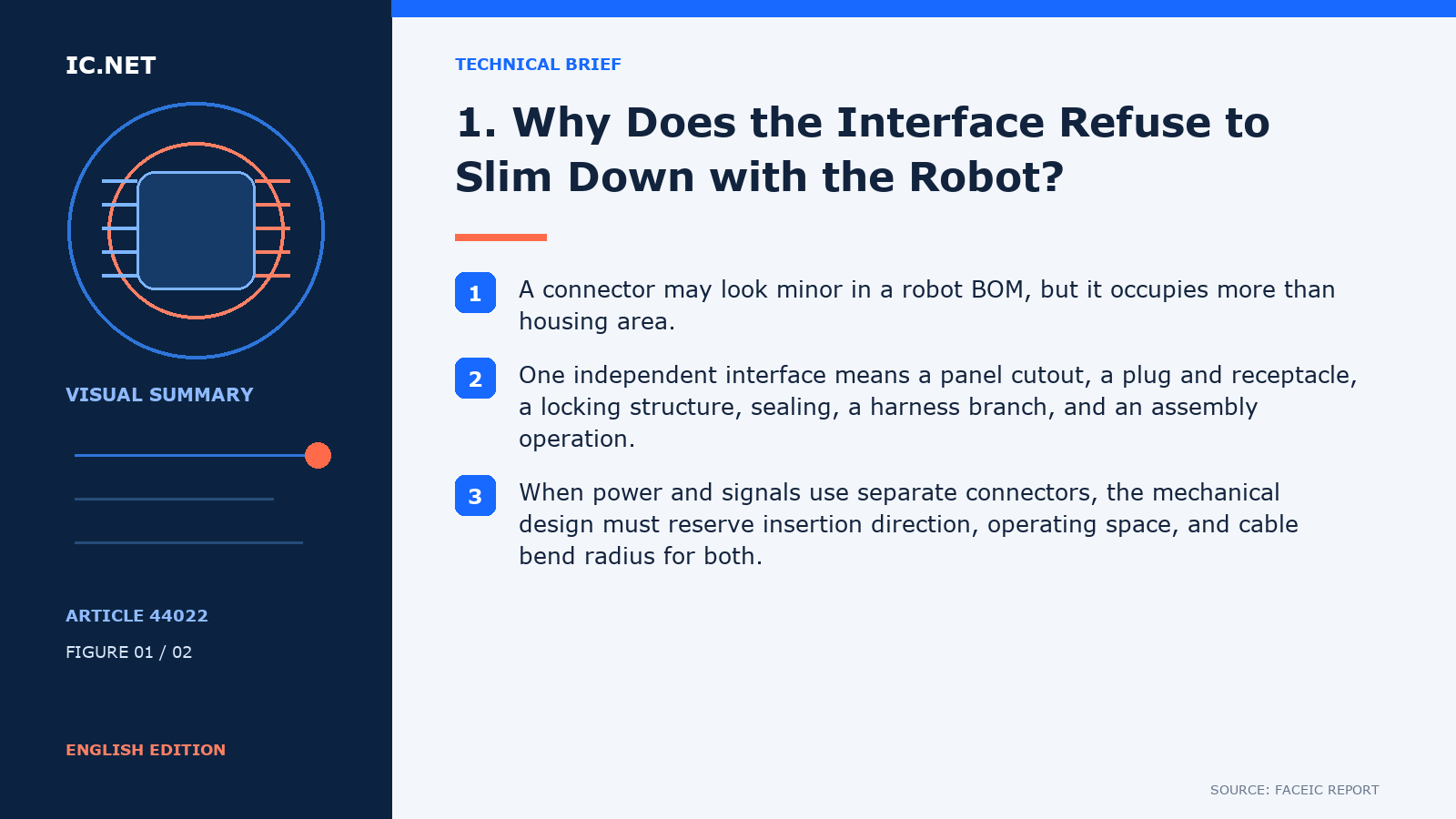
A connector may look minor in a robot BOM, but it occupies more than housing area. One independent interface means a panel cutout, a plug and receptacle, a locking structure, sealing, a harness branch, and an assembly operation. When power and signals use separate connectors, the mechanical design must reserve insertion direction, operating space, and cable bend radius for both.
That space is expensive in a small industrial or collaborative robot. A connector cannot simply be hidden on the rear because maintenance personnel need access. A sharply edged housing is also undesirable in close human-robot operation, where it can create collision or abrasion risks. JAE therefore gave KN07 a rounded housing and a one-touch push lock whose state can be confirmed by touch, addressing competition for space among mechanical, electrical, and service requirements.
KN07 uses crimp termination for cable diameters of 22.3-23.3 mm. Its contacts are gold-plated copper alloy, while the shell is aluminum alloy with a black electrophoretic coating. Combining power and signals can reduce panel openings and external connection count. It does not make the cable itself thinner.
2. Seventy-Two Contacts Are Not an Arithmetic Exercise: 10 A Times 32 Is Not 320 A
The 32 power contacts are rated at 10 A per contact and 250 V AC, while the 40 signal contacts are rated at 4 A per contact and 50 V DC. The numbers are impressive, but the most dangerous engineering response is to multiply 10 A by 32 and announce that the connector can carry 320 A.
A per-contact rating does not mean every contact can remain at that rating simultaneously. Available current also depends on ambient temperature, heating from adjacent contacts, wire gauge, crimp quality, harness cooling, and system derating. JAE specifies an operating range of -10°C to +85°C and notes that the temperature rise caused by energized operation is included. In engineering terms, selection requires the worst-case simultaneous-contact pattern, not only the pin count.
Nor do 40 signal contacts automatically mean 40 high-speed data lanes. JAE's release specifies 4 A per contact and 50 V DC, but does not provide differential impedance, bandwidth, crosstalk, or a particular communications protocol. Suitability for encoder, sensor, safety I/O, or communications signals must be determined from the full data sheet and system testing. The label "signal" is not evidence of industrial Ethernet capability.
The same boundary applies to IP67, cULus, and TÜV. They establish a product-level protection and certification basis. They do not automatically qualify the complete robot for water ingress, EMC, functional safety, or reliability. Terminal crimping, cable entry, assembly tolerances, and field service all affect the final result.
3. One Less Housing, Four More Validation Tasks: Integration Moves the Problem
A composite interface can free space on the robot. Separate power and signal connectors can converge into one external interface, reducing panel area, connector count, and assembly operations. A one-touch push lock can also simplify installation, removal, or field replacement.
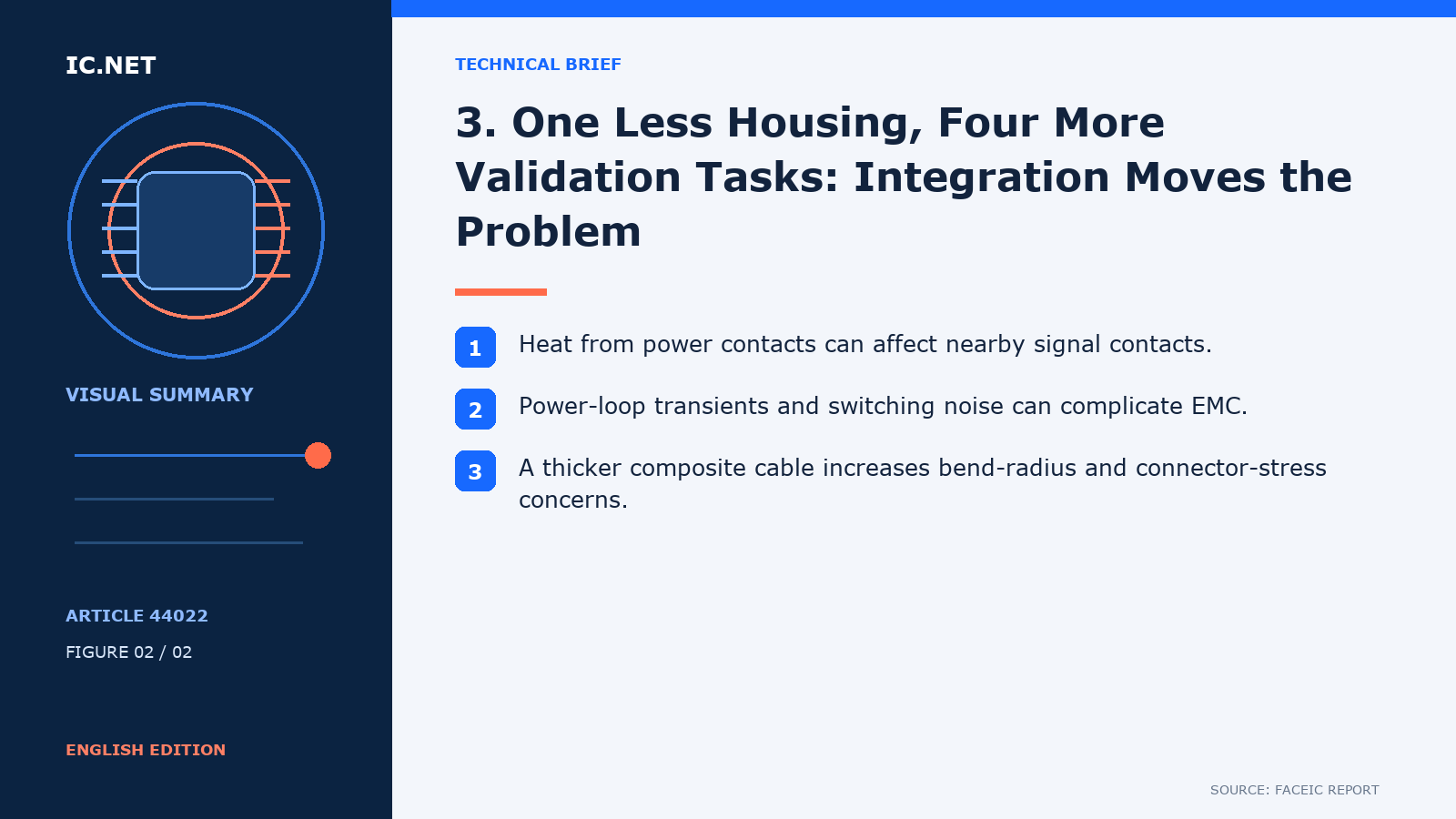
The risks converge too. Heat from power contacts can affect nearby signal contacts. Power-loop transients and switching noise can complicate EMC. A thicker composite cable increases bend-radius and connector-stress concerns. Failure of the single interface can remove power and signals together.
It is like joining two apartments into one large unit: the space is used more efficiently, but a utility failure affects a larger area.
A KN07 program should therefore validate at least simultaneous current and temperature rise, EMC and signal integrity, harness bending and connector stress, and vibration, sealing, and service operation. A composite interface does not eliminate complexity; it compresses complexity into a smaller, more concentrated system boundary.
4. KN07 Competes with Three Connection Architectures, Not One Part
Combining power, signals, and sometimes data in one connector is not unique to KN07. TE Connectivity's INTERCONTEC 723 and 740 series use M23 and M40 hybrid connectors that combine power, signal, and data, mainly for servo motors, drives, and automation equipment.
HARTING Han-Modular emphasizes modularity, combining power, signal, data, optical fiber, and even pneumatic lines in one connector for industrial equipment with complex or changing configurations. JAE's own KN06 takes another route: up to six modules and as many as 300 positions, oriented toward dense wiring in large equipment such as semiconductor tools.
KN07 instead uses a fixed high-density composite interface, a compact sealed housing, and one-touch operation, making it more closely aligned with external connections on small and medium robots.
None of the three architectures is universally superior. A fixed composite interface optimizes size and operation; a standard circular hybrid interface emphasizes the servo ecosystem; and a modular interface trades larger size and BOM complexity for configuration freedom. Robot manufacturers are choosing an external connection architecture, not merely a connector.
KN07 procurement also cannot compare plug prices alone. The cost model needs the plug, receptacle, contacts, seals, cable, crimp tooling, assembly labor, test fixtures, service spares, and second sourcing. The launch information alone is insufficient for a project selection. Complete orderable part numbers, mating life, derating curves, signal capability, and assembly specifications still require the formal data sheet, sample tests, and manufacturer confirmation.
Conclusion: the Robot Connector Is Becoming a System Component
KN07 shows that industrial-robot miniaturization is no longer only a contest among the motor, gearbox, and control board. The external interface's ability to combine power, control, maintenance access, sealing, and human safety also determines how small the finished robot can become.
The product does not really sell 72 contacts; it trades one composite interface for space on the robot body. The cost is that temperature rise, EMC, harness mechanics, and service risk must enter the system design earlier. A connector is no longer a part selected casually near the end of a program, but increasingly the boundary controller of the robot's electrical architecture.
One status boundary remains important. JAE has disclosed that KN07 was developed and placed on sale. It has not disclosed a specific robot customer, design win, or volume-adoption relationship. Market availability does not establish entry into a production robot BOM.
Disclaimer: This article is for industry discussion only and does not constitute investment, procurement, or part recommendations. Product parameters, certifications, and application status are subject to the latest manufacturer information and project-validation results.