
On August 11, NVIDIA put a concrete timetable behind 800 VDC power for data centers: an MGX power shelf designed to work with existing AC facilities is scheduled for the second half of 2026, initially for row-scale deployments.
At first glance, this looks like the long-awaited opening for China-based suppliers of SiC, GaN and power-control ICs. But four milestones are often blurred together: joining NVIDIA's ecosystem, putting a device into production, winning a customer design-in, and shipping in volume for an actual 800 VDC project. They are not the same thing. The architecture redistributes both BOM value and validation authority across the power chain. Many suppliers may earn an entry ticket; considerably fewer will clear every gate required for sustained orders.
1. 800 VDC will enter existing facilities first—the transition will not happen overnight
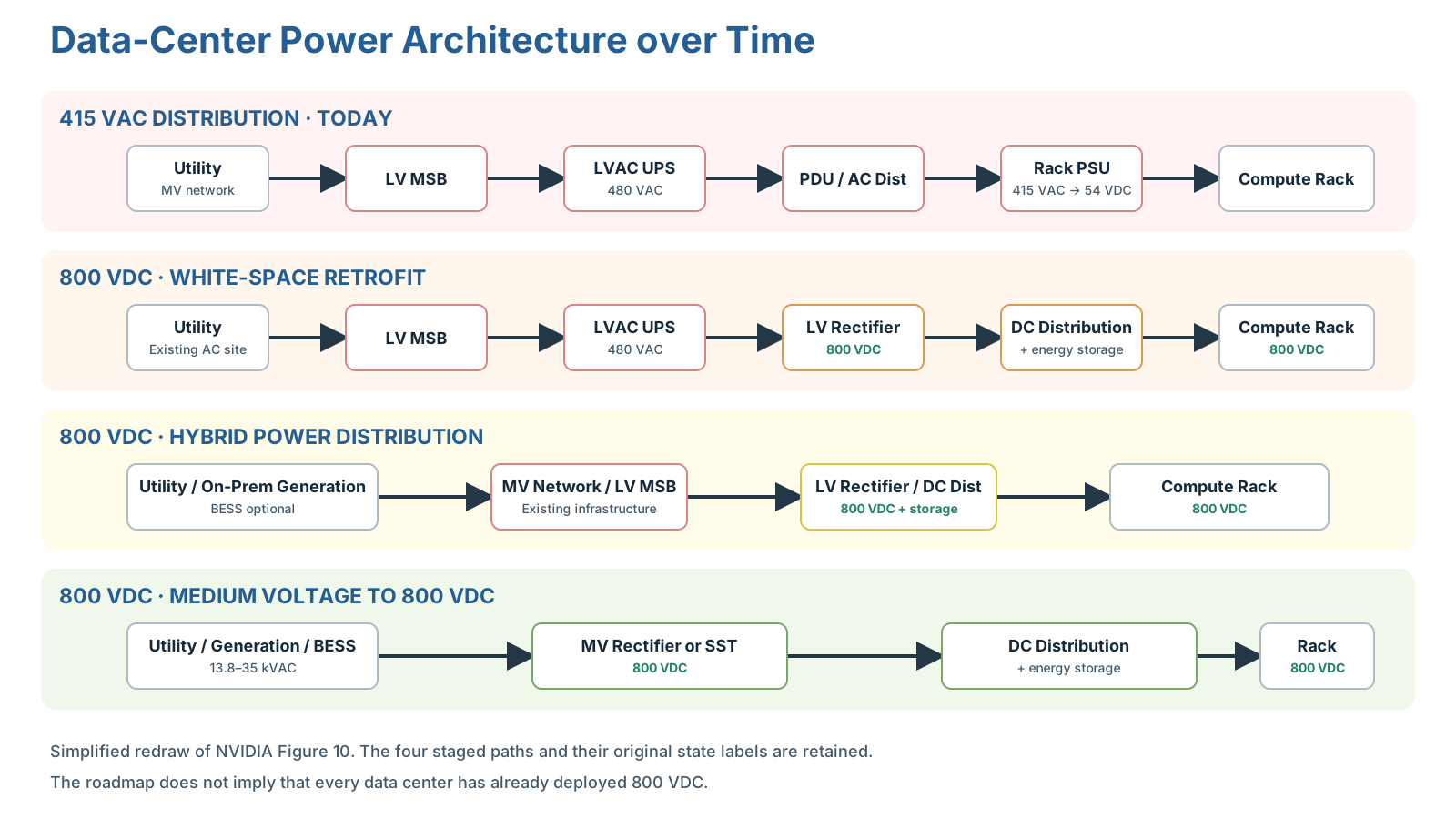
Most data centers today still bring 415/480 VAC to the rack, where a PSU converts it to 48/54 V before intermediate-bus converters and multiphase voltage regulators supply the GPU core. NVIDIA's near-term transition does not require an immediate rebuild of the facility. Instead, a sidecar power shelf is added beside the existing AC infrastructure. AC/DC rectification moves out of the compute rack, and an 800 VDC bus is delivered into the row or rack.
At this stage, 800 VDC is better understood as a migration bridge than as a universal replacement. NVIDIA's longer-term roadmap also includes facility-level low-voltage rectification and medium-voltage AC conversion directly to 800 VDC through medium-voltage rectifiers or solid-state transformers. OCP's SST specification v0.3, released in August 2026, belongs to that longer-range architecture as well.
Purchasing and engineering teams should therefore expect 415/480 VAC, 48/54 V and 800 VDC architectures to coexist for several years. Existing BOMs will not disappear in one step.
NVIDIA says more than 80 equipment and infrastructure companies are developing products around its 800 VDC specification. Its published partner list spans power semiconductors, modules, switching and protection, and data-center equipment.
2. Conversion stages have not vanished; they have moved out of the rack and closer to the GPU
The clearest benefit of 800 VDC is the ability to transmit more power at lower current. With a fixed conductor size, NVIDIA's white paper calculates 157% more transferable power than at 415 VAC. That is an architectural comparison, not a guaranteed energy-saving figure for every site. The more important change is spatial: valuable rack volume is no longer reserved first for bulky PSUs, while rectification, storage and protection migrate to sidecar shelves, row-level equipment or facility infrastructure.
The high-voltage side needs 1.2 kV-class SiC, high-voltage silicon devices, gate drivers, digital controllers and DC protection. Once 800 VDC enters the rack, designers must also manage fusing, hot swap, reinforced isolation, connector interlocks and arcing. Closer to the GPU, voltage falls and current rises; the BOM share of 100 V GaN or shielded-gate-trench MOSFETs, power stages, multiphase controllers, planar magnetics and high-frequency capacitors can become more important, not less.
In other words, 800 VDC does not simply reduce component count. It changes where components are deployed and which stages absorb system losses.
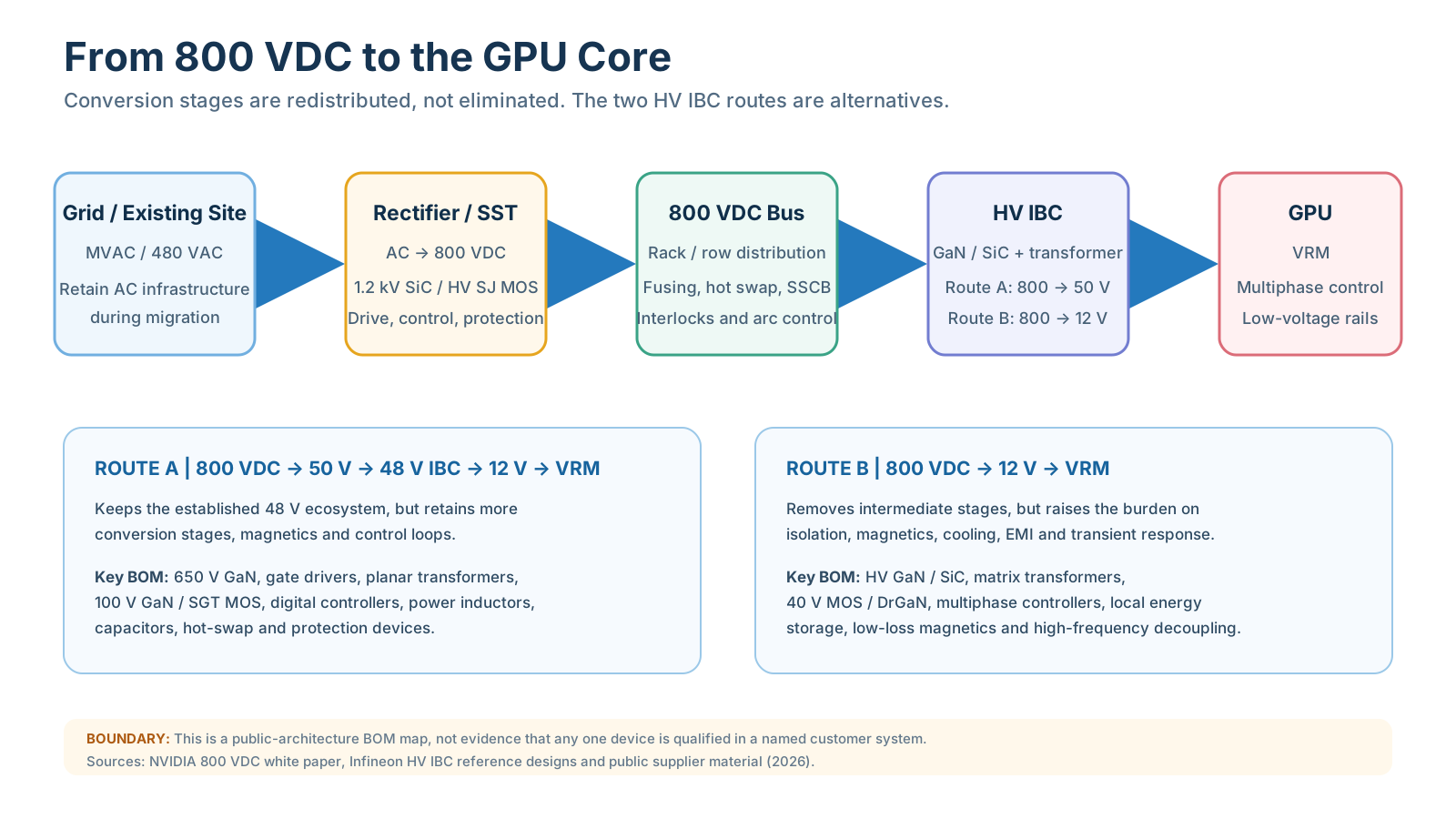
Power still passes through several conversion stages inside the compute node. One route converts 800 VDC to 50 V and connects to the existing 48 V intermediate-bus ecosystem. A second route converts 800 VDC directly to 12 V before the multiphase VRM. The first is easier to migrate but retains more conversion stages. The second reduces component count and board area, but places tougher demands on isolation, magnetics, thermal design, EMI and transient response.
NVIDIA's reference analysis indicates that direct 800 VDC-to-12 V conversion can improve efficiency by about one percentage point and reduce core-area footprint by 26% relative to a multistage architecture. These are theoretical results for a reference design, not universal field measurements.
Infineon has introduced two high-voltage intermediate-bus reference designs. Its 800 VDC/±400 V-to-50 V design uses two 3 kW units and exceeds 98% efficiency at full load. Its ultrathin 800 VDC-to-12 V design is rated at 6 kW TDP, reaches 98.2% peak efficiency and can support a 10.8 kW transient for 400 microseconds.
Those specifications are impressive, but they also show how the competitive threshold has moved beyond the on-resistance of one MOSFET. GaN or SiC, gate drive, control, transformers, energy storage and cooling must now work as one system.
GPU load can jump from light load to full load in a very short interval. NVIDIA's white paper proposes local storage such as electrolytic capacitors for fluctuations shorter than 100 milliseconds, with supercapacitors or batteries covering longer events. The new opportunity is therefore not one universal power IC, but a coordinated BOM for storage, protection and power smoothing that also interacts with control software.
3. China-based suppliers are making progress—but the exact BOM position still matters
Innoscience has disclosed the clearest near-term progress. Its interim 2026 results say shipments of AI and data-center chips rose 183% year over year. More than 100 high-voltage and 100 V products covering 800 VDC and 48 V/12 V applications have entered design-in at more than 20 global cloud-service-provider customers, and some devices have begun volume shipment. A 15 V DrGaN intended for the final 6 V-to-1 V GPU rail, however, had only completed customer sample testing.
Those statements describe three different maturity levels. They should not be compressed into a claim that Innoscience has already entered NVIDIA server supply chains at scale.
In the more established server-PSU market, an Innoscience customer case says Great Wall Power uses its ISG6122TD and ISG6123TD 700 V SolidGaN devices. That demonstrates deployment of China-developed GaN in server power supplies. It does not prove that native 800 VDC racks have already reached volume deployment.
Oriental Semiconductor's public position is closer to “production devices plus a full-chain roadmap.” Its product listings mark 1,200 V SiC MOSFETs such as OSQ120R025QDT2F as in production. A recent white paper maps superjunction MOSFETs, SiC, GaN, digital controllers, shielded-gate-trench MOSFETs and VRM controllers across PSU, intermediate-bus and voltage-regulator stages.
The company nevertheless describes commercialization of the 800 V architecture and a 12-inch GaN ecosystem as medium-term objectives. Having production-qualified component families establishes a basis for project evaluation; it does not prove that those exact part numbers are already on the BOM of a specific 800 VDC AI rack.
Conclusion
800 VDC is creating a larger addressable opportunity for China-based power-semiconductor suppliers, but the doorway does not lead directly to orders. Innoscience has disclosed design-ins, initial volume shipments and rapid shipment growth across different products. Oriental Semiconductor has production SiC devices and a broad power-chain roadmap.
The next separation among suppliers will come from coordinated delivery of devices, drivers, controllers, magnetics, protection, manufacturing consistency and customer-verifiable production evidence. For procurement and engineering teams, the useful question is not how many suppliers have “joined the ecosystem.” It is whether a specific part is being sampled, designed in, piloted in limited volume or shipped reliably at scale—and at which voltage node, in which topology and under which validation conditions.
This article is based on public information and is intended for industry discussion only. It is not an investment, procurement or part-number recommendation. Confirm product specifications, supply relationships and validation status with the manufacturer, customer and authorized channel.