
Clock speed and feature lists are relatively easy to match. What determines whether an engineer will keep selecting a device—and whether a company will commit it to volume production—is the mature, stable and maintainable platform behind the chip.
Open a catalog from a China-based MCU vendor today and the breadth is immediately visible. Product families now extend from low-power general-purpose control to real-time control, industrial connectivity and automotive safety. The market is no longer short of another MCU model. It is short of complete product and service systems that reduce development friction, support dependable production and can be reused across multiple generations.
The question has therefore changed. It used to be whether a China-developed MCU was usable. Now it is why an engineering team should choose one particular China-based MCU platform. The substitution premium alone is fading; platform quality and ecosystem depth are becoming the real basis of competition.
1. Look past the highest clock rate: an MCU must be sufficient, usable and dependable
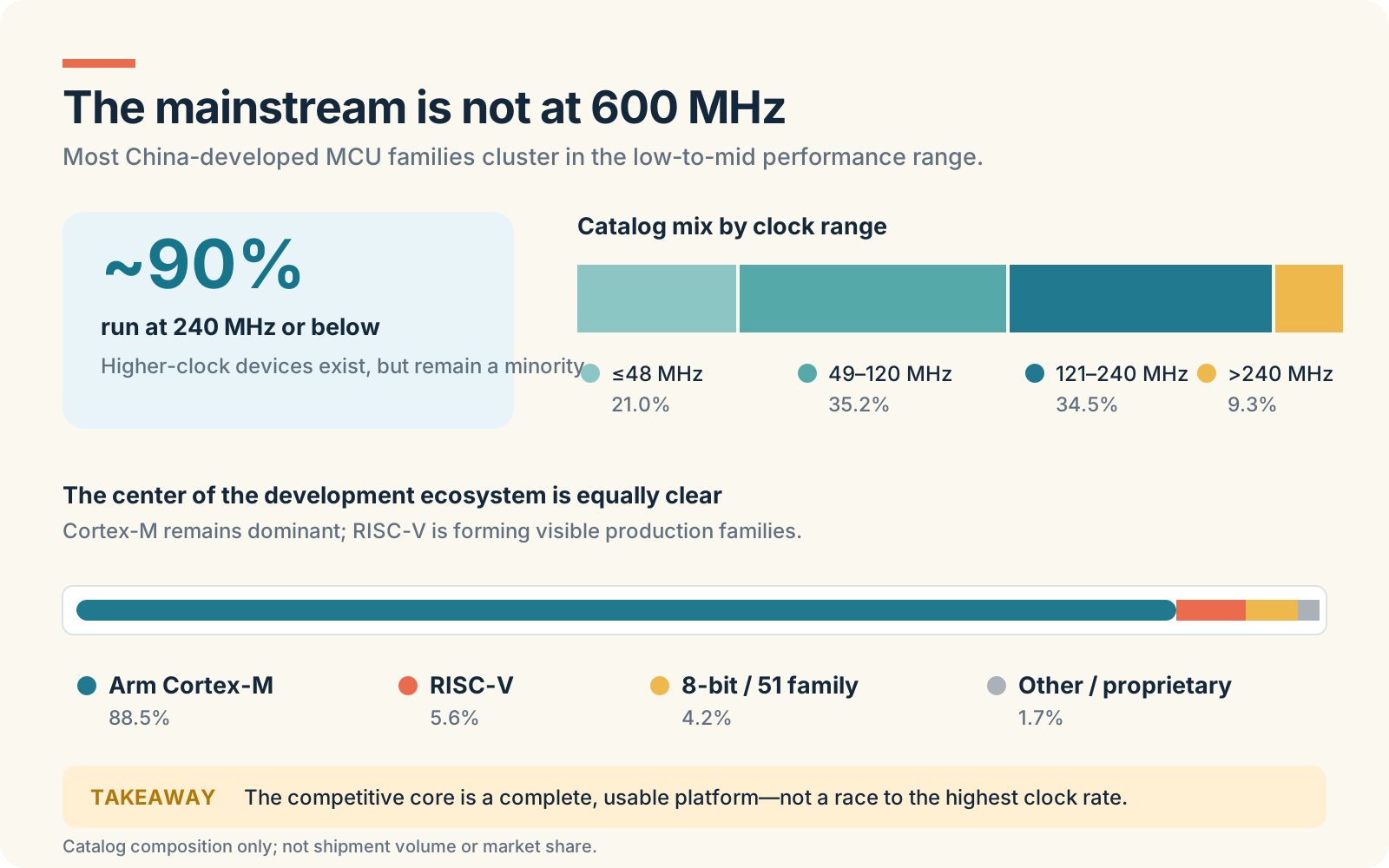
MCU discussions easily turn into a specification race: higher core frequency, more flash or the first device to cross 600 MHz. Most real MCU applications, however, do not run large AI models or render complex graphics. They control fans, pumps, industrial instruments, chargers, sensors and automation nodes, repeating the same operations millions of times.
For those systems, stability, unit-to-unit consistency and noise immunity matter more than a headline specification.
Across the current China-developed MCU catalog, devices at 240 MHz and below still make up the mainstream. Arm Cortex-M remains the center of the development ecosystem. RISC-V has progressed from experimentation into production products for connectivity, real-time control and higher-performance industrial systems, but it is unlikely to displace the mainstream architecture in the near term.
High-frequency flagships reveal a supplier's technical ceiling. Market penetration, however, depends on the stability, usability and application support of mainstream parts.
That distinction also corrects a common misconception: 48 MHz and 120 MHz MCUs are not inherently low-end. In many industrial and consumer systems, that processing budget is sufficient. Standby power, EMC robustness, ADC accuracy, peripheral fit and total system cost matter more. Getting those fundamentals right creates more engineering value than adding clock speed that the application will never use.
2. Beyond one-for-one replacement: suppliers are building differentiated positions
China's MCU sector is no longer one crowded lane of look-alike replacements. Vendors are developing along several technical routes and using their own strengths to establish differentiated positions. Four broad directions stand out.
General-purpose control and portfolio breadth. GigaDevice and Artery Technology began with entry-level general-purpose MCUs and have extended toward higher performance. Puya Semiconductor and Xiaohua Semiconductor emphasize low power, wide operating voltage and cost-sensitive applications. Nations Technologies and MindMotion add op amps, comparators, motor-control peripherals and security functions to simplify the surrounding system. The contest here is not a single benchmark win, but a continuous product ladder supported by packages, memory choices, peripherals and development tools.
Real-time control for demanding industrial systems. Servo drives, digital power and multi-axis equipment require deterministic response, accurate timing and tightly integrated control resources. HPMicro's HPM6E00 combines dual-core RISC-V processing, EtherCAT, TSN time synchronization, advanced PWM and encoder interfaces. Geehy's G32R501 integrates precision PWM, high-speed ADCs and real-time control resources for industrial applications. These products target workloads that go well beyond basic housekeeping control.
Connectivity-led ecosystems. Some vendors differentiate through protocol expertise rather than core specifications alone. WCH integrates mature wired interfaces such as USB and Ethernet into its MCUs. Espressif builds around wireless connectivity, supported by its protocol stacks, examples and toolchain. In these cases, the customer is selecting a communication platform and development environment, not only a chip.
Automotive control and functional safety. ChipON, AutoChips, Yuntu Microelectronics and SemiDrive approach the market from body control, general automotive MCUs and higher-performance vehicle control platforms. AEC-Q100 qualification, ISO 26262 evidence, MCAL drivers and standardized safety deliverables are no longer optional advantages; they are basic entry requirements for many vehicle programs.
Certification or a reference design only establishes eligibility for evaluation. It does not by itself prove volume availability or complete interchangeability with an incumbent device.
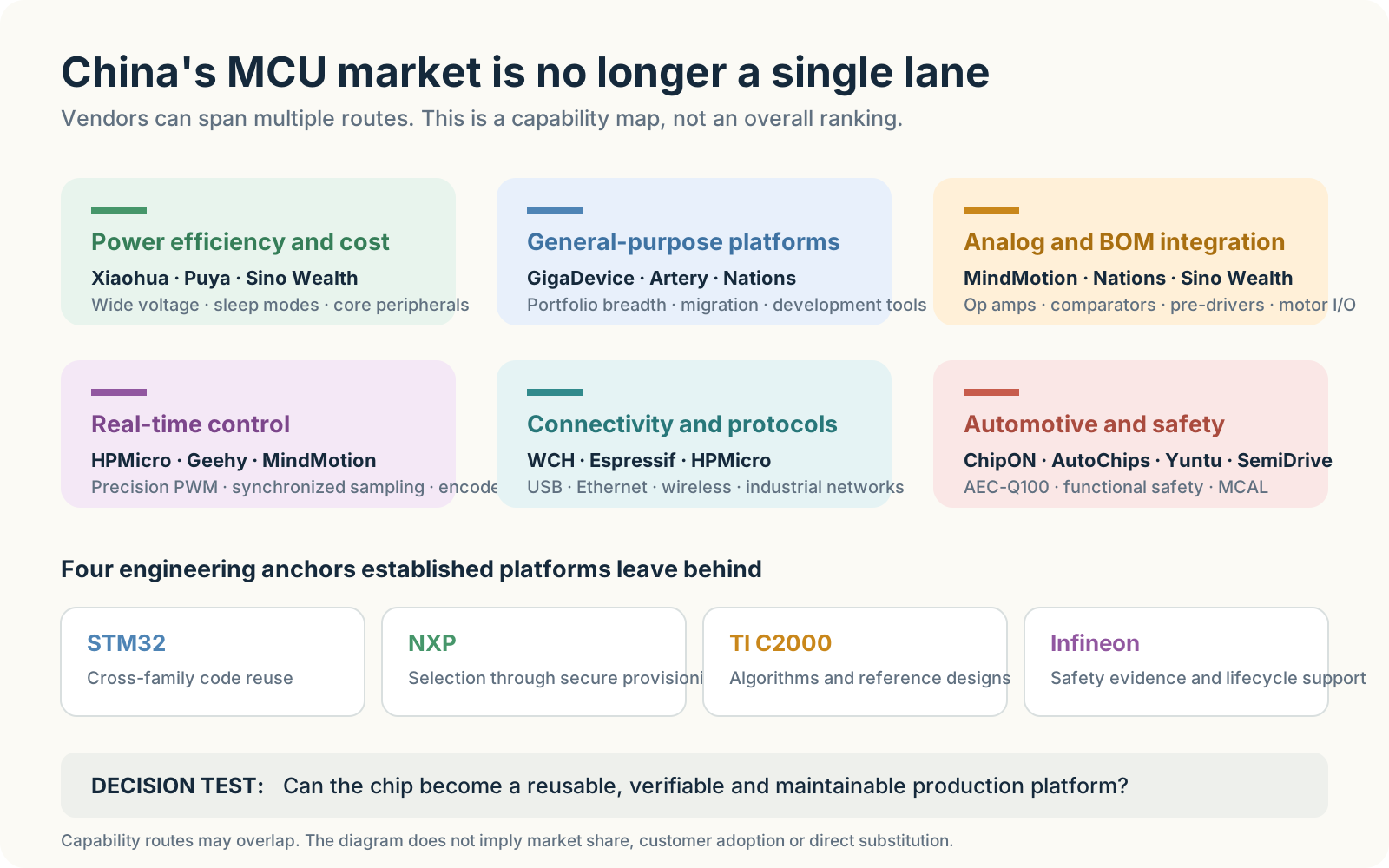
These directions overlap. A general-purpose MCU may serve motor control, a connected MCU may enter industrial automation, and an automotive MCU still needs a usable software foundation. Differentiation matters because it lets each vendor build a defensible engineering advantage instead of competing only on a replacement claim.
3. Similar specifications do not create a default platform
On a line-by-line comparison of clock rate, ADCs and interfaces, some China-developed MCUs already match international alternatives and occasionally publish more aggressive specifications. Yet engineers rely heavily on capabilities that never fit into a short parametric table.
STM32 combines a product ladder from entry level to high performance with STM32Cube drivers, middleware, boards and reusable code. NXP connects its MCX portfolio to MCUXpresso tools, configuration flows and secure provisioning. TI's C2000 ecosystem includes motor-control and digital-power algorithms and reference designs. Infineon's AURIX platform emphasizes functional-safety software, documentation and partner support.
The real benchmark is therefore not merely whether a vendor provides an IDE. Interfaces should remain consistent across families; legacy projects should migrate predictably; examples should survive contact with real hardware; errata should arrive promptly; third-party middleware should be available; and tool upgrades should not break existing programs. Automotive and industrial users also need safety deliverables, version maintenance, responsive field support and long-term supply.
That is the practical advantage of established international platforms. They are not always best on every metric, but engineering teams know them and can estimate the risks.
China-based suppliers occupy different positions. Some lead on individual specifications, some win specialized designs through integration, and others are filling gaps in automotive safety documentation. Far fewer have shown that these capabilities can be reproduced consistently across several product families.
The decisive test is whether one successful design win becomes platform experience that the same engineering team wants to reuse in the next product generation.
4. Four long-term accounts to settle before selecting a China-developed MCU
An MCU decision cannot rest on a data sheet and an introductory price. Engineers and purchasing teams should examine four longer-term questions.
Is the function set sufficient? Look beyond the core and clock rate. Confirm that PWM, ADC, communications and analog peripherals can complete the actual control task.
Does it simplify the system? An integrated op amp, pre-driver, EtherCAT block or security module matters only if it genuinely removes BOM items and debugging work.
Can the design pass validation? Check the exact product family, qualification level and certificate scope. Keep supplier reference designs separate from customer production evidence.
Will the platform still be maintainable in five years? SDKs, documentation, development boards, field support, errata and supply plans all matter. A break in any one of them can turn a low-cost chip into an expensive program.
Being searchable in a catalog and available as a sample makes a product easy to start with. Passing validation, shipping consistently and remaining supported makes it safe to produce. Closing that gap is the central task for the next phase of China's MCU industry.
Conclusion: the industry must move from "usable" to "trusted for the long term"
China-developed MCUs are now serious candidates across low-power control, analog-rich integration, real-time industrial control, connectivity and automotive safety. Strong and recognizable product lines have emerged in each segment. Product capability, however, does not automatically create platform status.
The next phase will not be decided by the largest model count or the highest clock speed. It will be decided by vendors that build production platforms engineers find mature, stable, low-friction and reusable over many years.
When engineering teams stop asking whether a China-developed MCU can work and instead compare which China-based platform is best for sustained production and iteration, the sector will have completed its more important transition—from product breadth to durable engineering preference.
Disclaimer: This article is for industry analysis and discussion only. It is not investment, purchasing or part-selection advice. Confirm specifications, qualifications, availability and implementation details with the manufacturer or an authorized channel.