
CIOE 2026 opened in Shenzhen on September 9. The exhibition halls were full of attention-grabbing terms: 1.6T, 3.2T, NPO, CPO and XPO. At first glance, conventional pluggable optical modules might seem close to becoming obsolete. Yet the first day's reporting pointed in another direction. Several leading suppliers had completed customer qualification and established production capability for 1.6T products, while 800G still accounted for the main shipment volume. Most 3.2T and faster offerings remained in sampling or validation.
Why do orders lag the pace of technical announcements? Data centers buy systems that can be installed, cooled, serviced, made interoperable and operated reliably—not a ranking of headline data rates. CPO has substantial advantages, but those advantages do not make it the immediate answer to every deployment. Pluggables retain the benefits of standardization and serviceability.
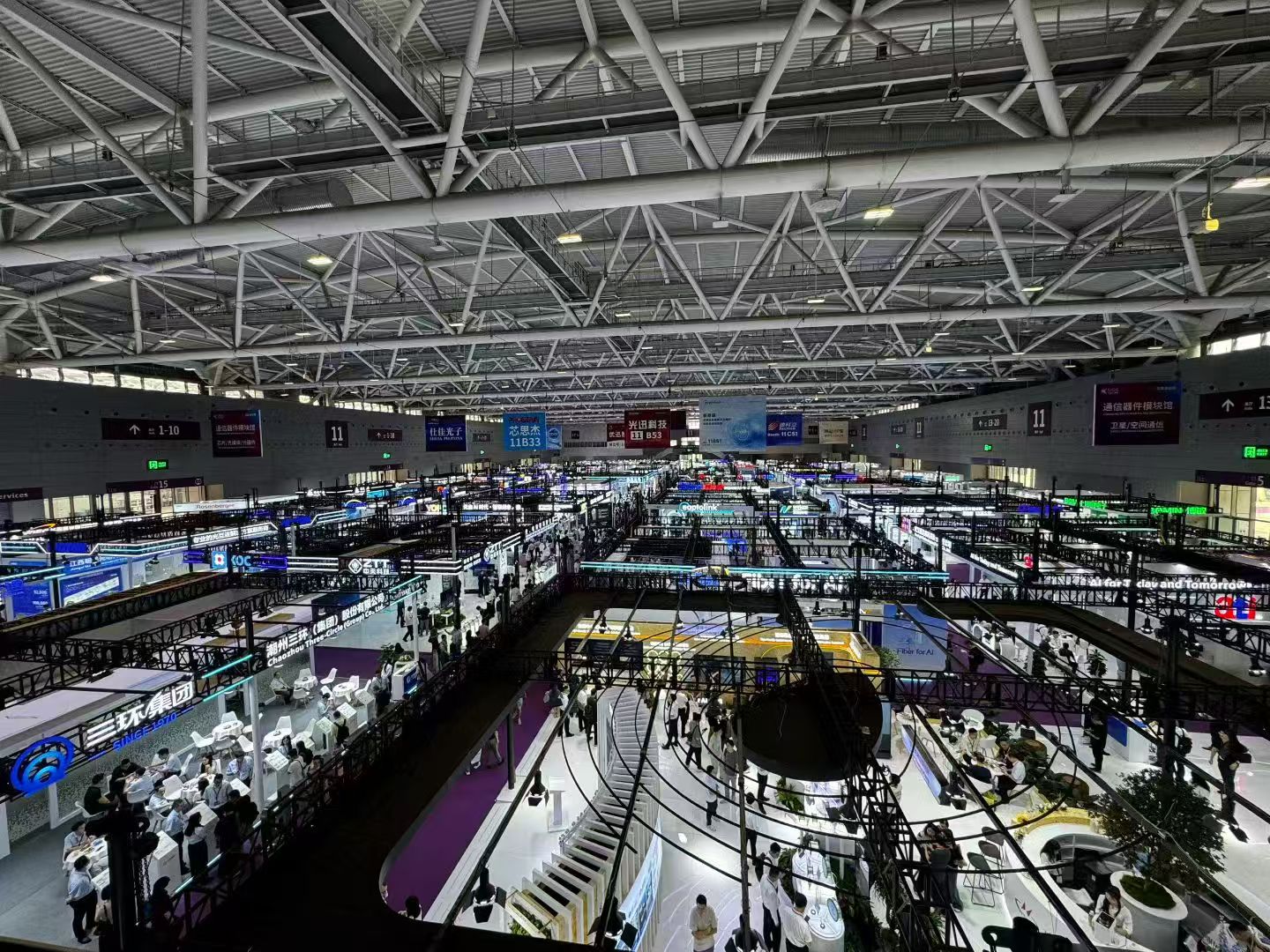
Figure 1. CIOE exhibition venue. Original photograph retained; the caption is localized into English.
1. If 1.6T is in production, why does 800G still lead shipments?
A 1.6T pluggable typically aggregates eight electrical lanes operating at roughly 200G each to deliver 1.6 Tbps. Eoptolink has published a 1.6T OSFP family with distinct deployment options. EOLO-13T-5H-XMX supports 500 m DR8 links using MPO-16. EOLO-13T-02-XMX extends DR8-2 reach to 2 km. EOLO-16T-02-XXX supports 2 × 800GbE over two duplex LC interfaces, also at 2 km. Although all are described as 1.6T, their connectors, fiber counts, reach and breakout options differ. The label on the housing is not enough for procurement.
Eoptolink's first-half 2026 report states that it had entered volume delivery of 1.6T optical modules. HGTECH's interim report likewise says its HG Genuine subsidiary had achieved global, large-scale delivery of 800G and 1.6T products. That does not mean 800G disappears overnight. Deploying 1.6T requires coordination with switching platforms such as the 102.4T generation, host SerDes, firmware and CMIS management, forward error correction, fiber cabling and thermal design. Module production capability and a data center's readiness to change platforms are different milestones. Continued 800G shipment leadership reflects staggered platform transitions, not a failure of 1.6T technology.
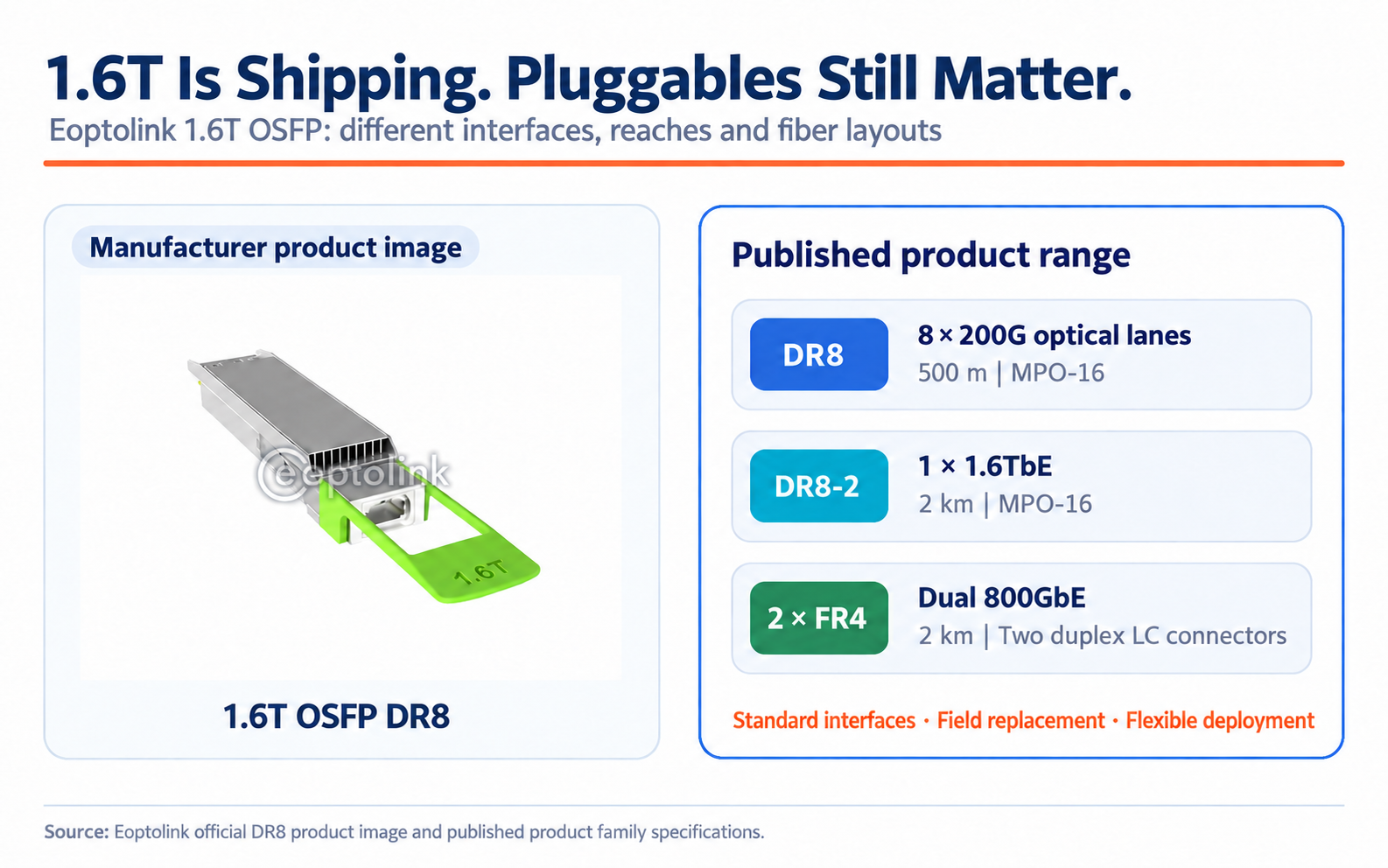
Figure 2. Eoptolink product image with an English-localized summary of its published 1.6T OSFP range. Interfaces, reach and breakout choices determine different deployment requirements.
2. CPO brings optics closer to the chip. What still limits adoption?
The attraction of co-packaged optics is straightforward. A conventional pluggable sits at the front panel. Electrical signals must travel from the switch chip through the package, PCB and connectors before reaching it. As data rates rise, that path becomes harder to manage in terms of loss, equalization and power. CPO places optical engines within the switch chip's co-packaged system, shortening the electrical path and converting high-density traffic into optical signals earlier.
Broadcom's announced Tomahawk 6–Davisson platform offers 102.4 Tbps of switching capacity with sixteen 6.4T optical engines and 200 Gbps per lane; its external laser modules are field-replaceable. Coherent has also shown a socketed 6.4T silicon-photonics CPO solution using 32 × 200G. CPO has moved well beyond a laboratory concept.
However, shortening the electrical path introduces packaging and operational costs. Bringing expensive switch ASICs and optical engines into the same system makes package yield, fiber coupling, thermal interactions and fault isolation more demanding. A failed front-panel module can be unplugged and replaced. An optical-engine fault in a CPO system can require service at the level of the whole switch platform. External lasers ease part of that maintenance burden, but they do not automatically resolve multi-vendor interoperability, connector cleanliness, spare-parts management or replacement cost.
Scale-out networks place considerable weight on standards, reach and field service, supporting the continued use of pluggables. Scale-up links prioritize bandwidth density, low latency and low power, making NPO and CPO more attractive. The architectures serve different network requirements rather than simply competing for one identical task.
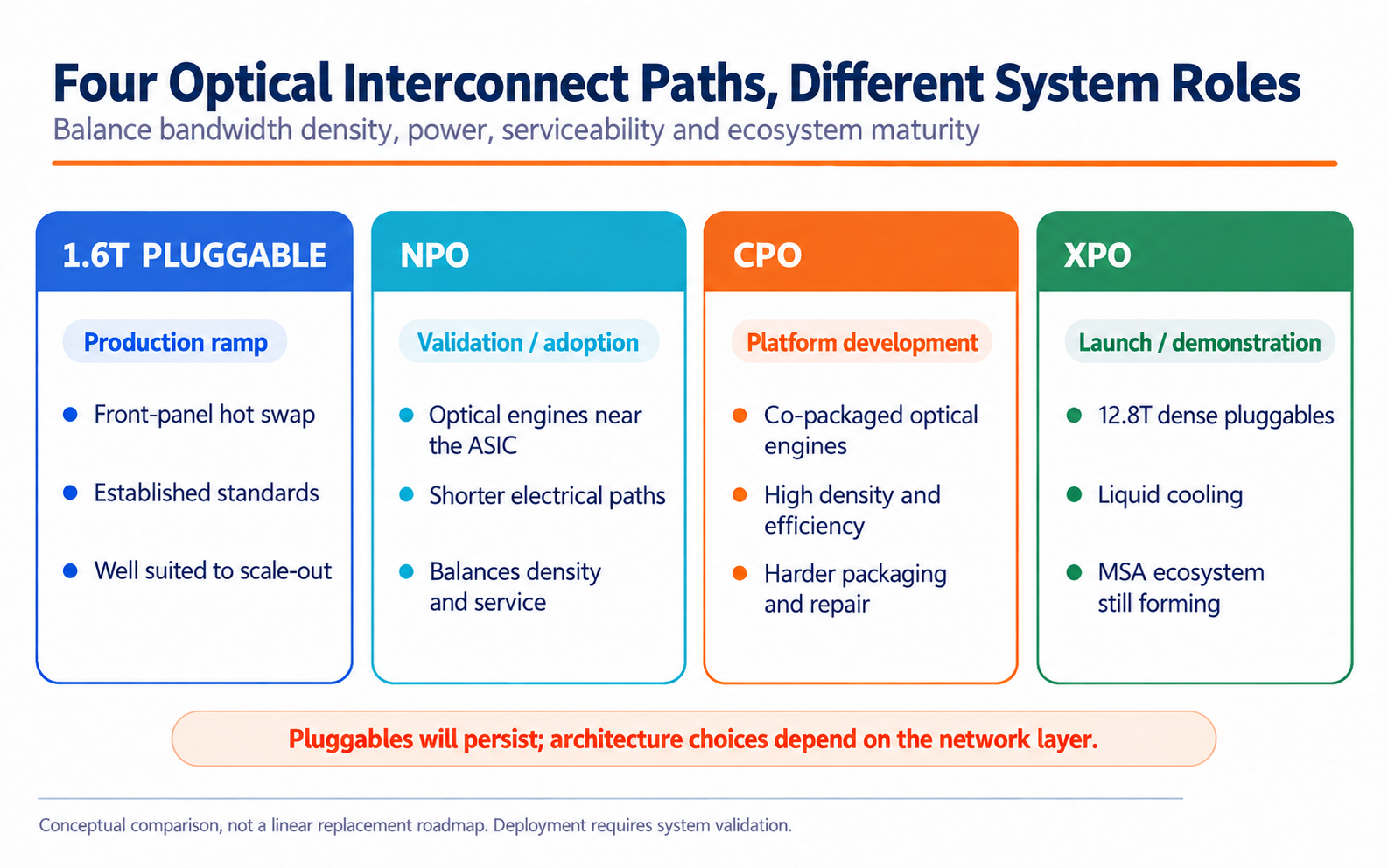
Figure 3. 1.6T pluggables, NPO, CPO and XPO do not form a simple linear replacement sequence. Status labels describe the context of this report, not every supplier's implementation.
3. NPO and XPO are attempts to balance competing requirements
Near-packaged optics puts the optical engine close to the switch chip, shortening the high-speed electrical path while seeking to preserve serviceability for the engines, external lasers and fiber-management modules. Accelink's published 3.2T NPO system combines optical engines, ELSFP external laser modules and an FMU-Shuffle fiber-management unit. The company reports full-system validation at a leading Chinese cloud service provider. It also showed a 6.4T silicon-photonics NPO design using 32 × 200G and a 12.8T XPO design using 64 × 200G, with front-panel pluggability and liquid cooling. System validation and exhibition demonstrations do not, by themselves, establish volume production.
HG Genuine's disclosures describe similar differences in maturity. Its 800G and 1.6T products were shipping at scale. Its 3.2T NPO had completed development and was being demonstrated live, while 3.2T/6.4T NPO products were undergoing customer tests and small-volume delivery. Its 12.8T XPO remained a sample-stage offering.
Eoptolink's announced 12.8T XPO brings together 64 lanes at 200G, front-panel pluggability and a cold plate rated for up to 400 W of cooling capacity. That cooling rating should not be read as measured module power consumption. XPO extends the pluggable approach toward higher density and liquid cooling, preserving a maintenance model customers value. Its multi-source agreement ecosystem is still taking shape, and connections, power delivery, cooling, software management and multi-vendor interoperability need further validation.
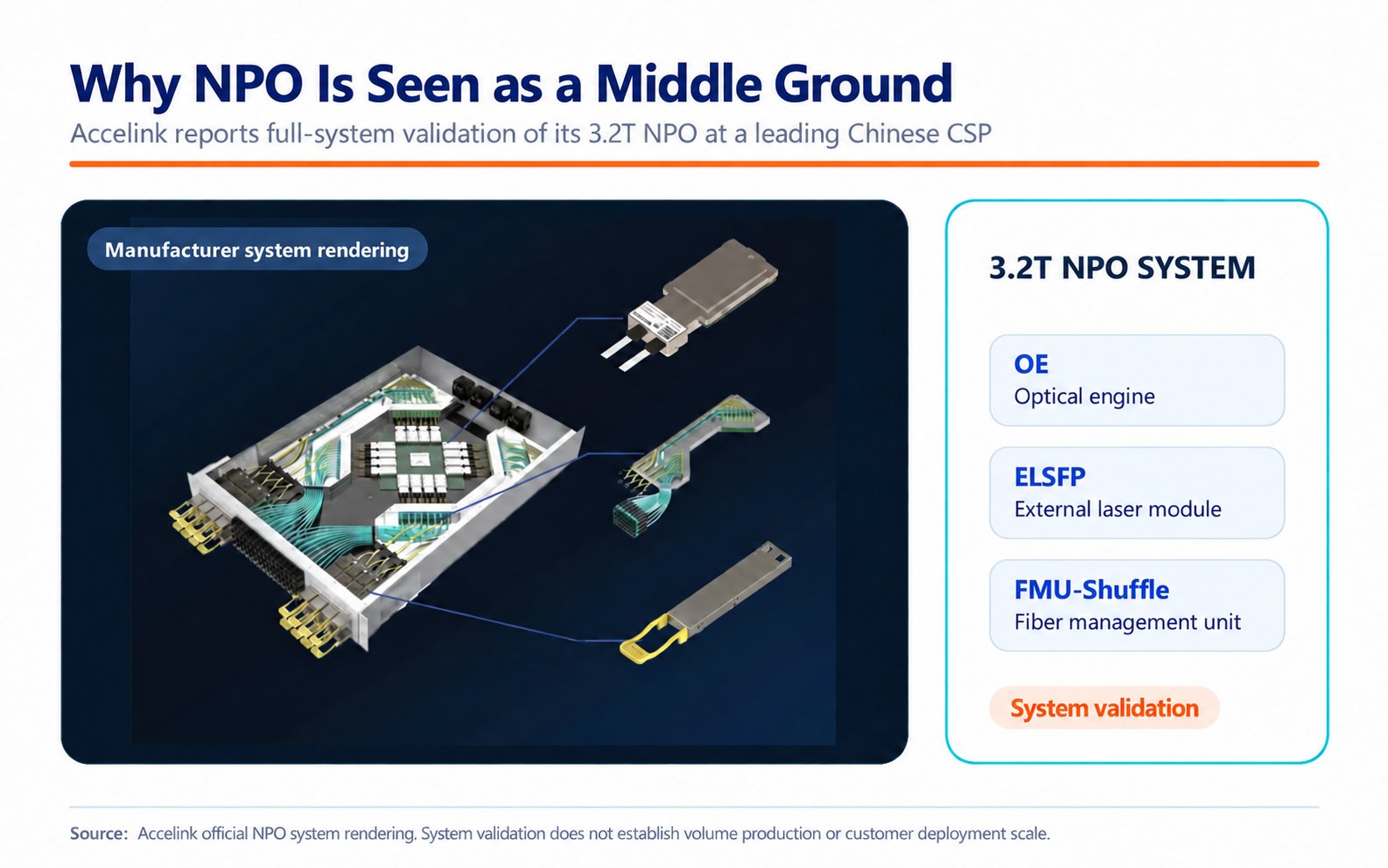
Figure 4. Accelink's published 3.2T NPO system rendering with English-localized annotations. Reported system validation does not identify the scale of a particular customer's production deployment.
4. China's suppliers are competing for more than positions inside a module
The transition from 800G to 1.6T and toward 3.2T puts pressure on more than module assembly. In August, HGTECH disclosed that shortages of high-end 1.6T DSPs and 800G LPO drivers had held first-half deliveries below expectations. By July–August, the reported availability of complete material sets had recovered to 70%. This is a procurement signal: bottlenecks can move among DSPs, drivers and TIAs, silicon-photonics PICs, EMLs, CW lasers, precision coupling, connectors and test capacity.
Chinese upstream suppliers now offer identifiable part numbers. Everbright Photonics lists EB-EML-5.5-1311-200-01 as a 1311 nm, 200G PAM4 EML chip. Its EB-DFB-200-1311-01 is a 1311 nm, 200 mW CW DFB chip targeting uses including 1.6T silicon-photonics modules and external CPO light sources. These listings show that Chinese suppliers are addressing 200G optical lanes and high-power continuous-wave sources. They do not establish that these specific chips have entered particular Eoptolink, Accelink or HG Genuine modules. Potential specification fit must not be presented as a confirmed supply relationship.
Engineering and procurement discussions therefore need to go beyond “Do you have 1.6T?” Which connector and reach? Does the design use a DSP, LPO or LRO/FRO? Are host SerDes and FEC requirements aligned? Is each module, optical engine and ELSFP at sample, qualification, small-volume or mass-production stage? Are high-temperature aging, bit-error-rate, replacement-service and lot-consistency results available? Without those answers, even 12.8T on an exhibition display says little about deployment readiness.
Conclusion
CIOE 2026 points to optical interconnects becoming more differentiated by application and more dependent on complete systems. It does not establish that CPO is about to eliminate pluggables. 800G continues to carry current shipments; 1.6T is ramping; NPO is working through system validation; CPO targets dense platforms; and XPO is extending pluggability toward 12.8T.
Over the next few years, the greater risk is to confuse an announcement with volume production, a single specification with system capability, or potential compatibility with an established supply relationship. Suppliers need to deliver higher speeds together with optical and electrical chips, packaging, testing, cooling and a workable multi-vendor ecosystem.
Disclaimer: This article is based on public materials and intended for industry discussion, not investment, procurement or part-selection advice. Product status and compatibility must be checked against manufacturer documentation and project validation.