Choosing wireless modules for smart lighting: lessons from a lantern festival
Hong Kong's Victoria Park is hosting an international Mid-Autumn lantern display from September 17 to 27, 2026. Its lantern street brings together more than 3,000 lanterns from 20 countries and regions. A Qinhuai lantern installation from Nanjing takes the form of a banyan tree roughly eight metres tall, with an illuminated canopy and hanging aerial roots that visitors can walk beneath. Other displays turn local foods, including egg waffles and milk tea, into lanterns, alongside markets, riddles and traditional crafts.

Figure 1. Mid-Autumn lantern display. The scene introduces the lighting application; it does not identify the wireless hardware used at the event.
For a team developing an interactive lantern or an adjustable ambient light, the engineering questions begin with how commands reach the device. Does it need only nearby phone control, or an internet connection? Will an existing microcontroller keep running the lighting application, or will that work move into the wireless module?
These decisions also apply to smart switches and small appliances. Products from Espressif, Ai-Thinker, u-blox and Silicon Labs provide useful comparisons for international buyers evaluating Chinese module suppliers. Each combination of silicon, module hardware and software assigns a different share of the integration work to the developer.
Espressif and Ai-Thinker take different routes to the module
Espressif builds the ESP32-C5-WROOM-1 and ESP32-C5-WROOM-1U around its own ESP32-C5 chip and supports development through ESP-IDF. Its September 2026 datasheet lists dual-band Wi-Fi 6, Bluetooth Low Energy and IEEE 802.15.4, together with a RISC-V processor running at up to 240 MHz and peripherals including LED PWM.
A team designing a new control board can use this combination to run connectivity, button handling and lighting effects within one module. Where processing capacity and interfaces are sufficient, a separate application MCU may be unnecessary. The LED driver and power supply still have to suit the load.

Figure 2. Espressif's original block diagram for ESP32-C5-WROOM-1 and 1U, showing the chip, memory and antenna arrangement. Source: September 2026 datasheet.
Ai-Thinker's BW60-12F follows a different supply path. Its April 2026 specification identifies a Realtek RTL8711FA-series chip, with dual-band Wi-Fi 6 and BLE 5.4. Ai-Thinker provides the module, general-purpose AT firmware and a route for custom application development.
A team with an established lighting board can retain its button and dimming code and let the host MCU communicate with the module through commands. A more extensive redesign can consider running the application inside the module. The BW60-12F's role therefore depends on the selected firmware and product architecture.
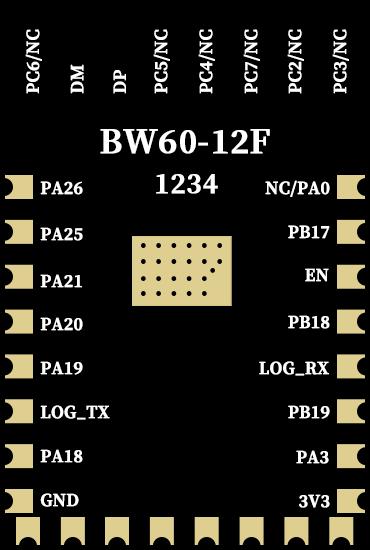
Figure 3. Official rear-view illustration of BW60-12F from Ai-Thinker's April 2026 specification. Interface use must be checked against the module configuration and firmware.
The distinction concerns who supplies the underlying chip, development framework and module support. Espressif brings those elements together within its own product family. An Ai-Thinker evaluation needs to consider both module documentation and the Realtek platform. Debugging responsibilities may sit with module hardware, AT firmware or the underlying SDK.
For sourcing decisions, a Chinese module brand and the origin of its underlying silicon are separate facts. That distinction affects software migration and technical support as well as the supply relationship.
Bluetooth nodes and Wi-Fi devices need separate comparisons
For nearby phone control, u-blox's NORA-B2 family provides a Bluetooth-oriented reference. NORA-B201 and NORA-B206 use Nordic's nRF54L15 and offer, respectively, an external antenna pin and an onboard PCB antenna. These are open-CPU modules. The October 2025 datasheet revision lists Bluetooth and IEEE 802.15.4 capability; these two devices do not integrate Wi-Fi.
They are relevant to a low-power local node. Adding control from outside the home would require a gateway or another network path, changing the system architecture. u-blox supplies the module while Nordic supplies the underlying chip and development ecosystem. This division resembles Ai-Thinker's use of third-party silicon, but does not imply shared software or direct interchangeability.
Silicon Labs' SiWx917Y belongs in the Wi-Fi comparison. It provides 2.4 GHz Wi-Fi 6 and BLE 5.4, with SiWG917Y operating as an SoC and SiWN917Y as a network coprocessor. The former can host the application; the latter lets an external MCU retain it while the module handles networking.
This product family gives developers a choice of integration models without adding 5 GHz. The SoC option is relevant when redesigning the board. A network coprocessor may better preserve an established host and its application code.

Figure 4. Selected products compared by connectivity and integration model, based on supplier documentation. This is not a measured performance ranking, a system-cost comparison or a substitution list.
The useful divisions cut across supplier geography. Espressif and Silicon Labs supply silicon, modules and development tools. Ai-Thinker and u-blox illustrate module products built around another company's silicon. Within either group, the next questions remain whether Wi-Fi is needed and where the application will run.
Radio coexistence and software determine the work involved
ESP32-C5-WROOM and BW60-12F add a 5 GHz option to the 2.4 GHz Wi-Fi available on the selected SiWx917Y products. That can help in a crowded 2.4 GHz home network, although propagation through walls, antenna placement and installation conditions still affect the result. A handheld lantern operated entirely over Bluetooth gains little from the extra Wi-Fi band.
Multiple protocols also share hardware resources. Espressif's ESP32-C5 coexistence documentation explains that, at 2.4 GHz, Wi-Fi, Bluetooth and IEEE 802.15.4 share the radio through time division, with different support conditions for different combinations. A lighting endpoint and a busy multiprotocol gateway place very different demands on that hardware. For Wi-Fi with Thread or Zigbee gateway applications, Espressif recommends a dual-SoC approach with independent radios.
Software entry points matter just as much. BW60-12F's general-purpose AT firmware provides a way to test command exchanges. Complex lighting effects, state restoration and update behaviour still need checking. NORA-B201 and NORA-B206 are open-CPU devices and should be distinguished from other models supplied with u-connectXpress software.
Nordic also offers a Bare Metal development option for simple Bluetooth applications on the nRF54L family. It can reduce dependence on a real-time operating system where the supported feature set fits the application. Projects needing more functionality must assess the full SDK. For a small control board, the software that a team has to maintain can be as consequential as another protocol on the specification sheet.
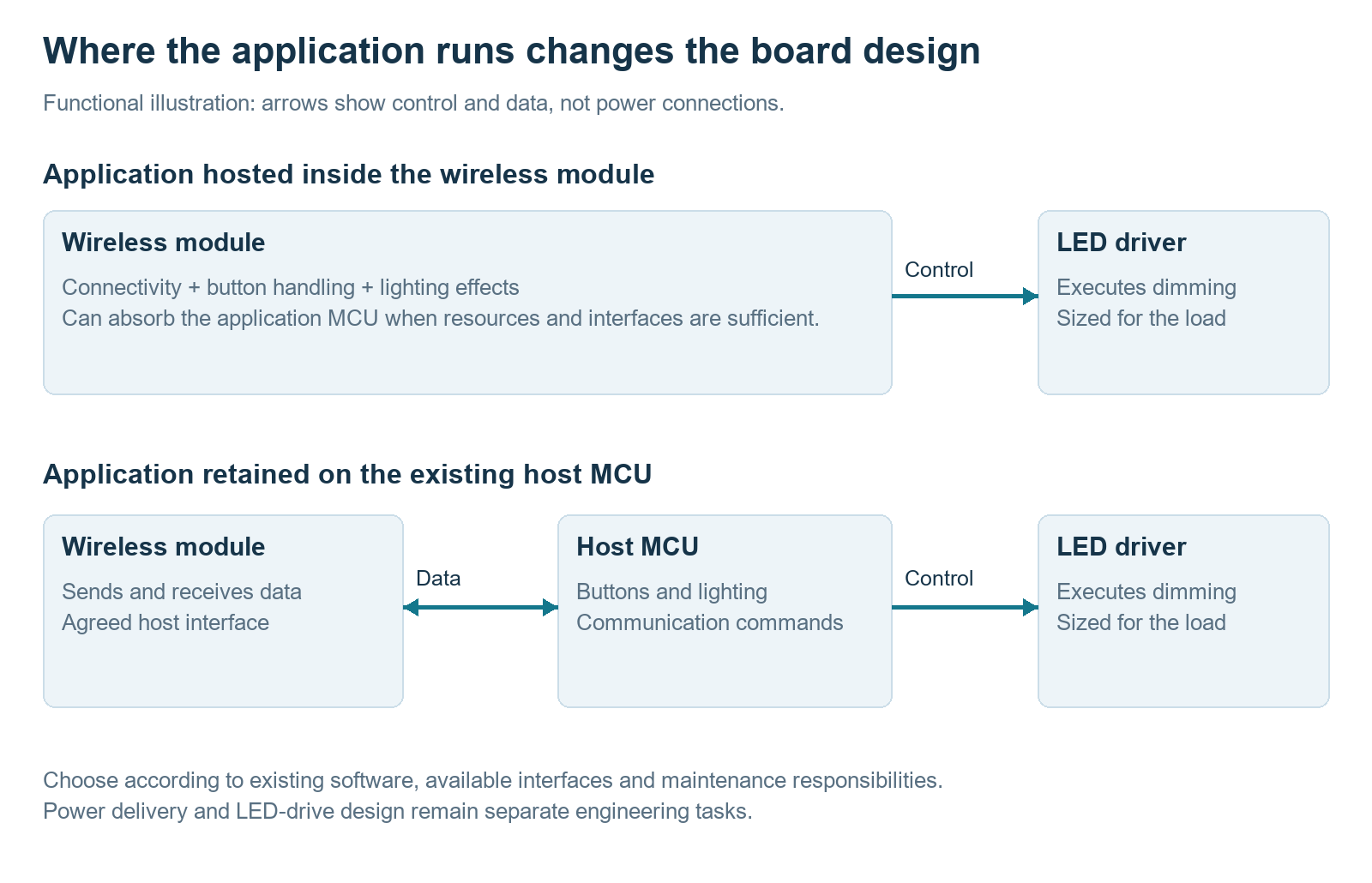
Figure 5. Application inside the wireless module, or retained on an external MCU. Arrows show control and data exchange, not power connections or proven compatibility.
Compare connected operation and maintenance costs
Power figures need their operating conditions. Silicon Labs lists 78 µA for SiWx917Y Wi-Fi associated standby at DTIM10. That describes a particular connection state and setting. It cannot be ranked directly against another module's deep-sleep current or treated as the consumption of a complete lamp.
A device that must receive commands at any time has to balance response latency against the cost of staying connected. A device that wakes on a button press and communicates occasionally can use a different sleep strategy. A useful battery-life comparison aligns traffic frequency, transmit power, connection state and peripheral load.
Ai-Thinker's specification calls for a supply capable of delivering peak current above 500 mA for BW60-12F. This is a power-supply design requirement, not a statement that the module continuously draws 500 mA. Average consumption affects runtime; transient supply capability affects whether radio activity causes voltage drops and resets.
Maintenance records reveal another part of the cost. Silicon Labs' June 2026 WiSeConnect 4.1.0 release notes describe a fix for Wi-Fi power saving failing to resume after an access point's beacon interval changed. Router behaviour can change after a product ships, so continuing firmware support can affect its operation in the field.
Certification evidence also belongs in a sourcing review. The NORA-B2 datasheet lists certification status by country and region. When the Chinese article's sources were checked, Ai-Thinker's BW60 page still marked its series certification documents as awaiting upload. This establishes a difference in publicly available documentation, not proof that BW60 lacks certification. Export projects need the applicable documents for the exact module version, antenna configuration and destination market before assessing remaining end-product work.
For a new board combining connectivity and application processing, Espressif C5 and Silicon Labs' SoC products offer relevant starting points. A design retaining its host MCU can compare BW60 firmware integration with SiWN917Y's coprocessor model. NORA-B201 and NORA-B206 deserve a separate evaluation for local low-power Bluetooth nodes.
The module choice determines how many processors remain on the board, where software development begins and who maintains the product after sale. Those are concrete grounds for comparing suppliers. A total-cost ranking would also need quotations at comparable volumes and delivery terms.
Based on the supplier material checked for the Chinese source article. Lighting applications are analytical examples, not claims of adoption at the festival, measured rankings or validated substitutions.