
China's Supercapacitor Suppliers: From Backup Cells to AI Power Modules
A meter that loses power needs enough energy to save its data. A machine that starts repeatedly needs a brief surge of current. An AI server needs its power system to follow rapid changes in load. Supercapacitors can serve all three jobs, but the relevant products range from small board-mounted devices to large cells and complete rack modules.
For engineers and buyers evaluating Chinese suppliers, that range is a useful starting point. Package, operating conditions and delivery format matter as much as the capacitance printed on a cell. A supplier of small backup devices and a supplier of grid-scale systems may both describe their business as supercapacitors while offering very different products.
Jianghai's first-half 2026 report illustrates the commercial scale already reached: supercapacitor revenue was approximately RMB249 million, up 54.18% year on year. That is revenue from the company's supercapacitor business. Other financial figures discussed below refer to total company revenue or planned projects and should be read on their own terms.
This overview covers 19 product or development entities: 18 mainland Chinese entities, plus Hong Kong-based Man Yue Technology and its associated Fu Hua De business. Torch Electron and Zhongke Supercapacitor belong to the same group. The aim is to give international readers a product-based supplier map, with established products, pilot activity and announced projects identified separately.
1. Small backup devices: leakage and package size shape the choice
Board-level backup usually asks a supercapacitor to keep a circuit alive briefly after the main supply disappears. In meters, controllers and data-retention circuits, installation space, leakage current, life under continuous charge and ambient temperature all affect the usable backup interval.
Fenghua Advanced Technology lists coin, cylindrical and combined electric double-layer capacitors, or EDLCs, alongside lithium-ion supercapacitors. Its cylindrical catalogue includes the FH2R7L405M-H0816, rated at 2.7V and 4F. In April 2026, Fenghua also disclosed progress on automotive supercapacitors that had passed AEC-Q200 Rev E reliability testing. Evaluation still needs the test results and temperature limits for the particular part under consideration.
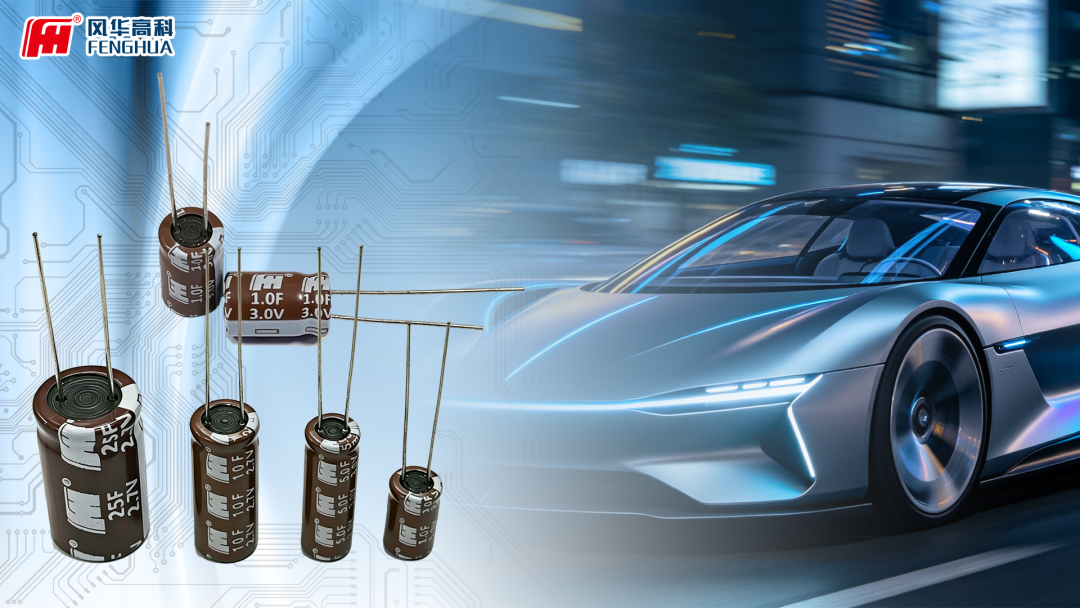
Figure 1. Fenghua's April 2026 manufacturer product image. The vehicle is an application illustration.
Beryl adds further voltage and temperature choices. Its current catalogue includes a BCT-series 2.7V, 100F example rated from −40°C to 85°C, and a BCV-series 3.0V, 250F example rated from −40°C to 65°C. The higher voltage comes with a different capacity and temperature range; package dimensions also need to fit the equipment.
Jianghai covers EDLCs, lithium-ion capacitors and modules. Its 2026 catalogue includes SGP leaded devices for board-level applications and SSE snap-in or solder-tab devices for larger storage requirements. Buyers can therefore compare different mounting formats within the same supplier's range.
Liaoning BIGCAP lists coin, leaded, combined, high-temperature and lithium-ion products, including the BCE, BRP, BMHT and BLIC series. Examples include 5.5V, 0.22F coin devices and the BMHT5R5L255FAW, a 5.5V, 2.5F combined device with a stated operating range of −40°C to 85°C.
For real-time clocks, meters and data retention, these package choices address different board layouts and voltage requirements. Sealing, leakage and humidity-temperature life affect the energy remaining after long standby periods. Lower leakage helps retain energy until a power interruption actually occurs. Circuit consumption, charging voltage and the minimum operating voltage then determine how long that stored energy can keep the load running.
2. High-current pulses: compare capacitance with resistance
Industrial starting, energy recovery and power buffering put more weight on output current. Larger capacitance stores more energy, while lower internal resistance helps limit voltage drop and heating. Both need to be assessed at the intended current and temperature.
Jianghai's SSE range includes a 3.0V, 300F specification with separate AC and DC resistance data. For a pulse lasting several seconds, DC resistance and its measurement conditions are particularly relevant. Supplier comparisons need a common test method.
Tianjin Plannano / Plan Energy announced two dry-electrode supercapacitors for AI data centers on September 15, 2026. Both are rated at 3.0V, with capacities of 370F and 400F. The manufacturer states that they support PCB mounting and accepts sample requests and volume orders. These devices address compact integration in server power shelves and can be compared with other suppliers' cells in the hundreds-of-farads range.
Qingyan Energy Storage distinguishes YPN standard, YPR low-resistance and YPS dry-electrode series, alongside titanium-based and energy-oriented products. It introduced a dry-electrode 60-format product in January 2026 and discussed dry-electrode supercapacitors for AI data-center power management in September.
Dry-electrode processing uses steps such as powder mixing, fibrillation and rolling to form an electrode film, reducing solvent-related operations. For a buyer, the process label establishes a line of enquiry. The part's resistance, heating and cycling data establish the pulse it can actually support. Those measurements need comparable voltage, temperature and current conditions.
HCC Energy announced 3V cells rated at 4,500F, 6,000F and 12,000F in April 2026, targeting power storage, frequency regulation and high-current applications. The manufacturer image shows the differences in cell size.
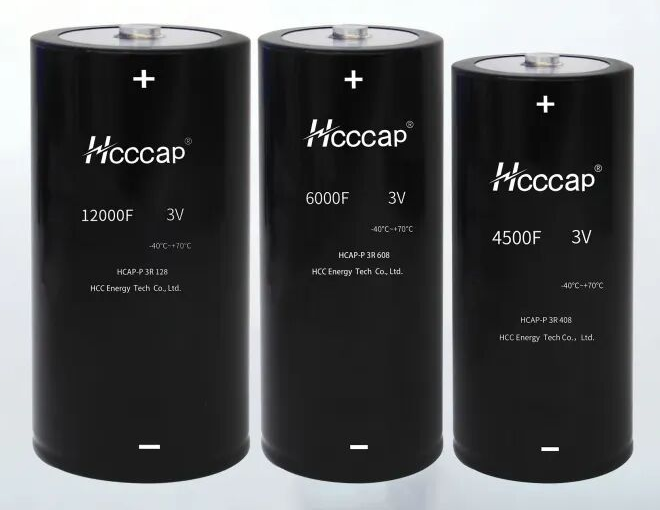
Figure 2. HCC Energy's 3V, 12,000F, 6,000F and 4,500F cells, left to right. Cropped from the manufacturer's April 2026 product image; product markings are retained.
Torch Electron and Zhongke Supercapacitor offer another product platform. Torch lists CSD and CSM carbon-based EDLC and combined products. Its first-half 2026 report describes the additional materials, cells, modules and integration capabilities obtained through the acquisition of Zhongke Supercapacitor, including a 3.2V EDLC platform with a disclosed capacity range of 1F to 3,600F.
Higher cell voltage increases stored energy at the same capacitance, while demanding more from the electrolyte, electrodes and long-term float-charge stability. Under the ideal capacitor model, a fully charged 3V, 300F cell stores 1,350J, or approximately 0.375Wh. The energy available to a circuit also depends on its discharge cutoff voltage. This helps explain both the usefulness of supercapacitors for rapid power support and the need for multiple cells when longer support is required.
Hongming Riwang focuses on environmental performance. Hongming Electronics' first-half 2026 report disclosed recognition of an ultra-low-temperature supercapacitor under a Hunan first-set product programme. Together with the manufacturer's aviation-oriented product positioning, this points to low-temperature starting, vibration resistance and customised assemblies as relevant evaluation areas.
Sichuan Jinshi New Energy / Jinshi Technology lists 3.0V cells at 3,000F, 3,200F and 3,400F. Jinshi Technology reported approximately RMB431 million in total company revenue for 2025; that figure does not describe supercapacitor revenue alone. Its first-half 2026 report discussed construction progress on a low-resistance supercapacitor manufacturing base and porous-carbon lines.
Fenghua also disclosed an updated full-tab supercapacitor on September 2. The structure is relevant to current collection and internal connections, but any quantified improvement needs the corresponding specification and test report.
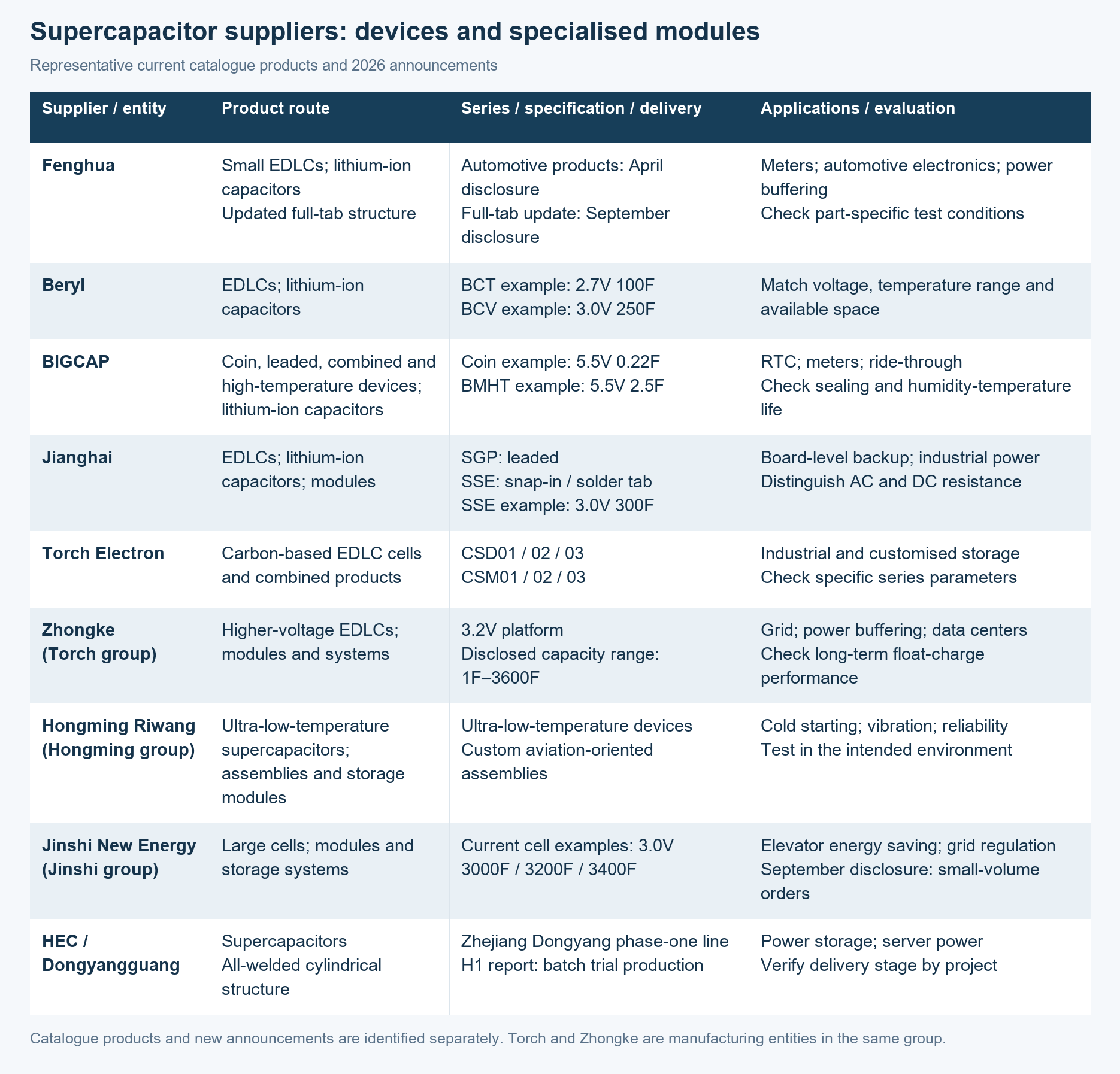
Figure 3. Representative device and specialised-module suppliers. Current catalogue examples and recent announcements are identified separately. Torch and Zhongke are separate manufacturing entities within one group.
3. Hybrid routes: energy and power require a common duty cycle
EDLCs store charge at electrode surfaces and suit rapid, frequent charging and discharging. Lithium-ion capacitors and other hybrid products use different electrode combinations to balance power capability with energy density. Their voltage windows, precharge requirements and life conditions differ, so comparisons need a defined operating duty cycle.
Shanghai Aowei offers EDLC and high-energy hybrid products, extending from cells to capacitor packs and systems for transport fast charging, energy recovery and grid frequency regulation. In June 2026, it signed a supercapacitor storage strategic cooperation and procurement agreement with Huanghe Tianwei New Energy. The announcement establishes a cooperation and procurement arrangement; project construction and operating results remain relevant follow-up evidence.
Ningbo CRRC New Energy spans materials, cells, modules and systems, with both EDLC and hybrid routes. Rail braking-energy recovery illustrates the operating demands: frequent energy absorption and release, repeated cycling, power response and system matching.
GMCC, part of the Sieyuan Electric group, publishes supercapacitor and hybrid cell and module products and describes a dry-electrode manufacturing route. Sieyuan's first-half 2026 report stated its intention to expand data-center business centred on supercapacitors. Its power-transmission and storage background provides context for evaluating integration with converters and distribution equipment.
TIGSTOR offers EDLCs, titanium-based products and systems. Its EDLC catalogue includes 3V cells at 230F, 300F, 350F, 800F and 3,000F. Public project information in August reported grid connection of a supercapacitor-plus-lithium-battery frequency-regulation project in Anyang, Henan, in which the company participated. The two storage technologies perform different roles under a coordinated control system.
Man Yue Technology / Fu Hua De, Hong Kong, adds the lithium-carbon capacitor, or LCC, route. Its portfolio includes EDLCs, LCCs, modules and storage cabinets. A July 2026 manufacturer announcement stated that a 20Ah LCC cell line had entered production at the end of June.
Hybrid-product literature may use Ah, Wh and F. EDLC energy can be estimated from capacitance and voltage, while hybrid comparisons benefit from measured charge-discharge curves and usable energy. A common output power, support duration and permitted voltage range makes the comparison more useful than ordering unlike products by farads.
Jinzhou Kaimei Energy and Xinlian Shidai also belong on the supplier map, with their disclosed development stages attached. August information on Kaimei's high-specific-energy supercapacitor project described planned first-phase investment of RMB300 million, a December production target and expected annual output value of RMB1 billion after production begins. These are project plans. Xinlian Electronics' 2025 annual report, published in April 2026, described construction of a 0.2GW pilot line at Xinlian Shidai and research on pouch-format ternary-system lithium-ion capacitors.
Available devices, contracted projects, pilot lines and facilities under construction represent different commercial stages. That distinction belongs alongside product parameters when evaluating these suppliers.
4. AI and grid applications: the deliverable becomes a module
Rapidly changing AI loads extend the supercapacitor's role from ride-through after an outage to power buffering while the main supply continues operating. Inside a rack, the relevant product includes series-parallel cells, balancing, protection, monitoring and a power interface.
TIGSTOR's published 60kW CBU solution uses 3V, 300F EDLC cells for AI power buffering. The power rating alone does not specify the support duration, which also depends on usable module energy and operating voltage. The rack-mounted format brings thermal management, control interfaces and recharge recovery into the supplier comparison.
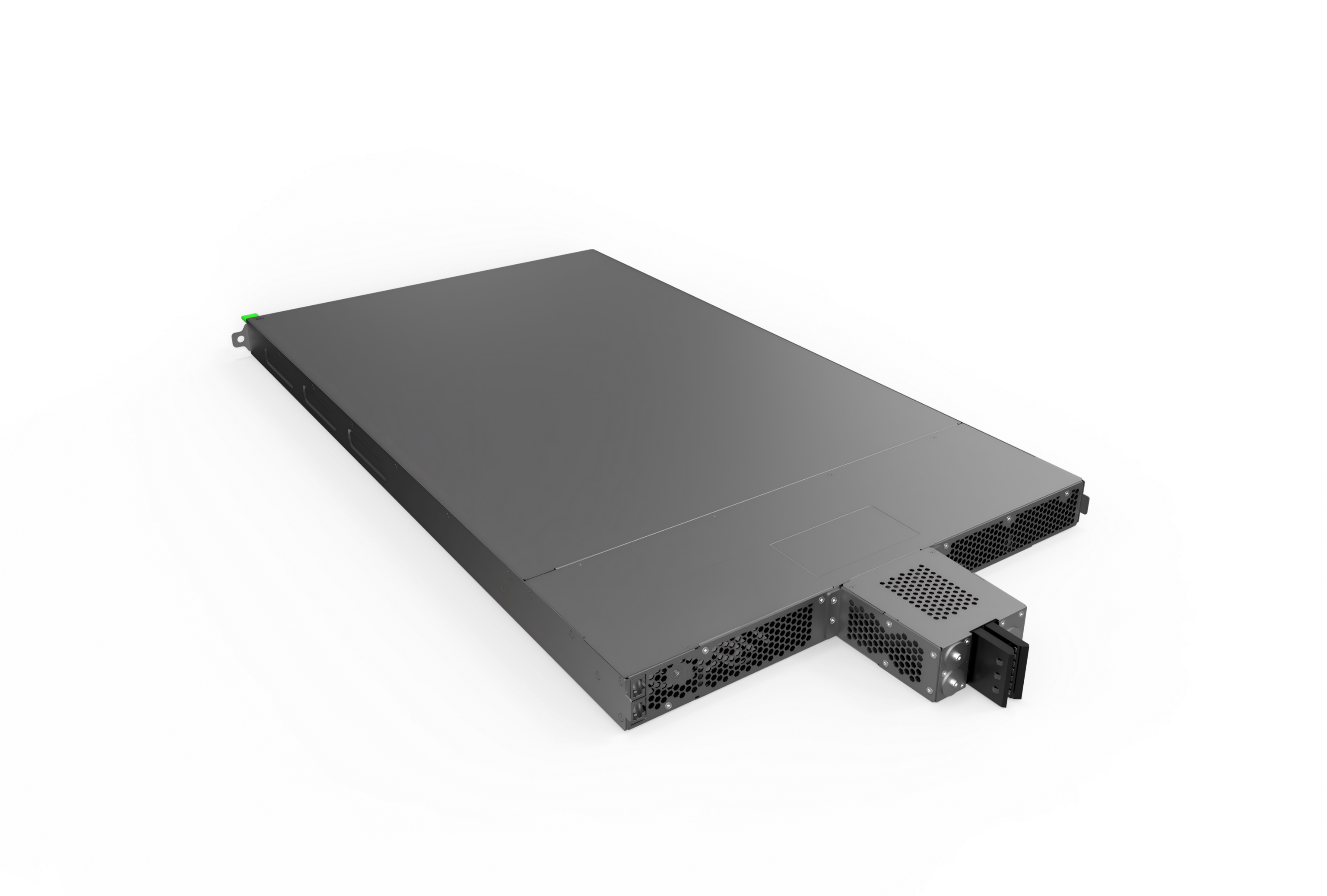
Figure 4. TIGSTOR's manufacturer rendering of its CBU product.
HCC Energy's CBU-800V / 600kW solution, announced in July, addresses an 800V high-voltage DC architecture and 600kW-class racks. Evaluation needs the bus voltage, converter arrangement and specified support duration, reflecting a different power-system position from small low-voltage backup devices.
HEC / Dongyangguang has disclosed manufacturing and supply-chain developments. Its first-half 2026 report stated that Zhejiang Dongyang Supercapacitor's first-phase line had entered batch trial production and described an all-welded cylindrical structure and internally developed fibrillated electrodes. A June strategic cooperation with Delta covered supercapacitor integration arrangements for solid-state transformers, server power supplies and UPS products. Subsequent evaluation should follow the transition to stable delivery and implementation in specific equipment.
Jinshi's first-half 2026 report described development of 15kW / 7.5kW off-grid elevator energy-saving cabinets, a 2.5MW liquid-cooled supercapacitor DC prefabricated unit, and a 1.25MW, 60-second supercapacitor prefabricated unit, with volume production expected in the second half. On September 11, the company disclosed small-volume orders for its supercapacitor business. These provide separate milestones for product development and commercial progress.
Qingyan also covers elevator energy saving, industrial energy recovery and power-quality management. Here, the interface to existing equipment becomes central: DC bus connections, bidirectional converters, recharge recovery and control strategy all affect the result. For Plannano, Qingyan and Jinshi, cell literature and system descriptions therefore need to be read together.
Grid frequency regulation and AI power buffering share the need for rapid charge and discharge, but their duty cycles differ. Grid systems emphasise dispatch response, cycling and system efficiency; server systems put more weight on bus dynamics, installation space and thermal management. The same supplier's cells can consequently support different module and control designs.
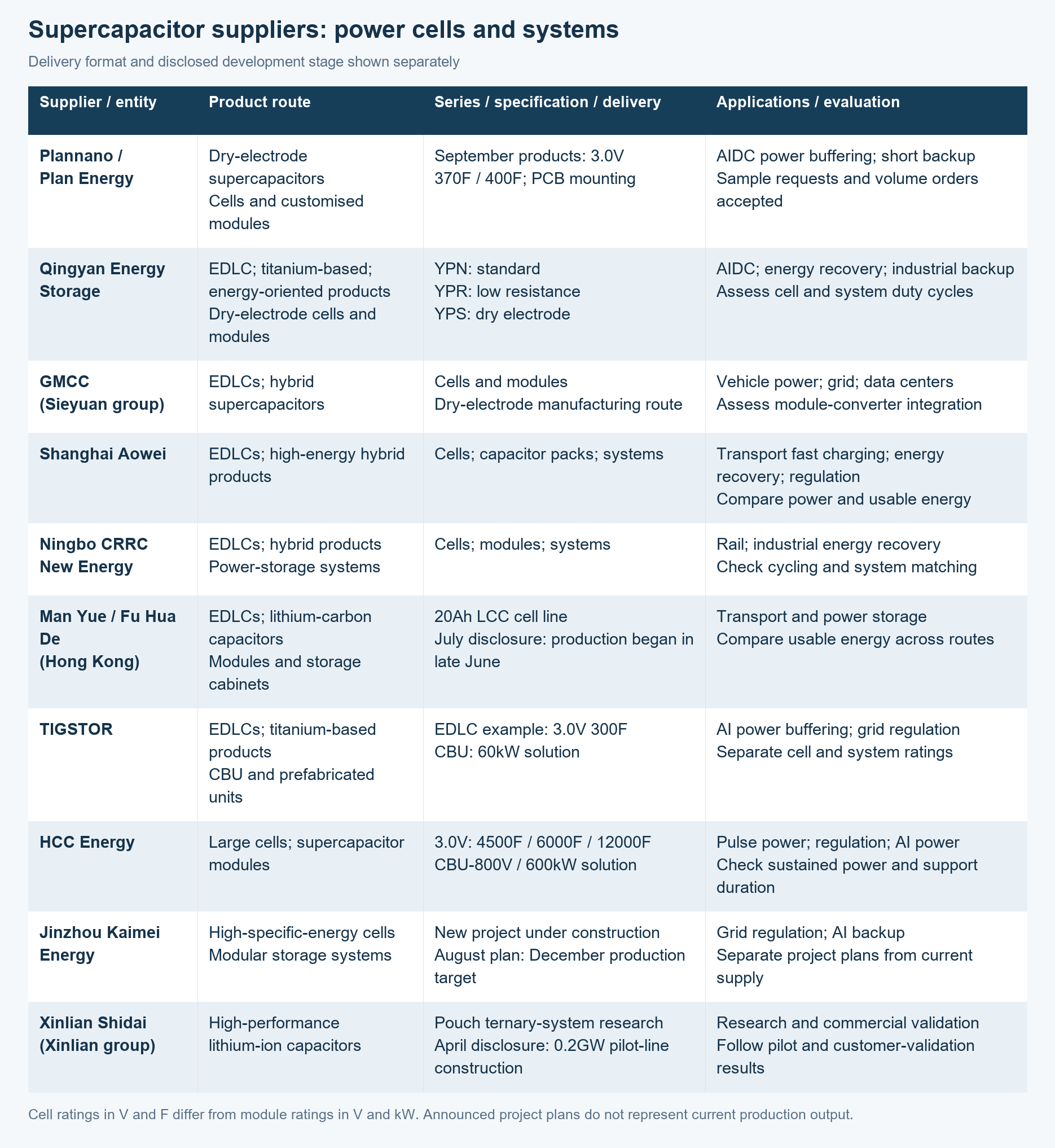
Figure 5. Representative power-cell and system suppliers. Cell voltage and capacitance are shown separately from module voltage and power. Construction and pilot activity retain their disclosed stages.
For an international engineering or procurement team, this map provides several practical entry points. Fenghua, Beryl, Jianghai and BIGCAP offer small backup-device ranges. Hongming Riwang and the Torch group add low-temperature or specialised assemblies. Plannano and Qingyan make dry-electrode cells more visible in the shortlist. HCC, Jinshi, Aowei, CRRC, GMCC and TIGSTOR extend the comparison into large cells, transport energy recovery and complete power systems. Man Yue and Fu Hua De add an LCC-based hybrid route.
The expanding choice is visible in what suppliers deliver: individual cells, protected and monitored modules, and systems coordinated with equipment power supplies. Small devices still need evidence of standby life and environmental performance. Large modules need evidence of stability under repeated power pulses. Recent announcements and project milestones make the product map more specific; continuing delivery and operating data will help establish how each product performs in service.