
China's automotive BJT suppliers compete on product fit and repeatable delivery
For engineers and buyers assessing Chinese automotive transistor suppliers, a broad catalogue is only the starting point. Silicon bipolar junction transistors (BJTs) serve signal switching, auxiliary control and drive functions, where modest device cost does not remove demanding temperature, electrical-stress and service-life requirements. Chinese companies participate through device supply, wafer manufacturing, reliability testing, and assembly and test services. Their public disclosures describe different stages of development, qualification and customer adoption. Those distinctions matter when deciding whether a supplier can support a particular programme.
Circuit choices determine automotive BJT demand
Recent international automotive BJT materials identify switching, control, and MOSFET or IGBT gate driving among their applications. A transistor performing one of these supporting functions does not address the same market as the main power switch in a traction inverter. Growth in electric vehicles therefore cannot be converted directly into a BJT market estimate.
Nor does greater electronic content establish a rising BJT count per vehicle. A design team may choose discrete devices or integrated driver and power-management solutions. Discretes allow local tailoring; integration may reduce external components and assembly steps. Function, board area, thermal design and total cost determine the choice. For a component supplier, the architecture selected for a specific programme is more directly relevant to orders than total vehicle sales.
Automotive sourcing also extends beyond price. Buyers need to establish that samples represent the intended production version, qualification evidence covers the relevant package and manufacturing conditions, and production quality records remain traceable. Board validation, documentation and inventory transition all contribute to the cost of changing suppliers.
A wider portfolio can help a company participate in a customer's component selection, while consistent delivery of a narrower range can support a specialised position. Company size alone does not rank automotive BJT competitiveness.
JSCJ and Galaxy offer different routes into customer programmes
JSCJ, known in China as Changjing Technology, places BJTs within a broad discrete-device portfolio. Its July 2026 exhibition material lists small-signal, power, digital and Darlington transistors in SOT, TO and DFN packages. An April automotive announcement includes transistors alongside power diodes, ESD protection devices and MOSFETs.
That breadth can simplify sourcing for a customer selecting several device types for one control board. Coordinated selection support, documentation and sampling may reduce the effort of dealing with separate vendors. Orders still depend on each device's suitability. The specific award and volume-supply disclosures in JSCJ's April announcement concern MOSFETs. They establish neither equivalent BJT shipments nor the production status of an individual automotive transistor programme.
Galaxy Microelectronics combines small-signal products with an integrated device manufacturer (IDM) model. Its first-half 2026 report lists small-signal and power BJTs and describes coordination between chip manufacturing and backend packaging capacity. Internal coordination provides an organisational basis for adjusting die, package or test conditions; shorter development cycles and better yields must still be demonstrated in the relevant project.
Galaxy also reports progress in automotive qualification and customer programmes. Categories explicitly associated with new design nominations or volume supply include MOSFETs, rectifier bridges and TVS devices. This experience can inform quality communication and project management, but it does not establish the same supply stage for BJTs. Each device still needs its own qualification and circuit fit.
JSCJ's disclosures emphasise portfolio coverage, while Galaxy's also highlight manufacturing coordination. Both can help suppliers engage customers, through different mechanisms. Counting all automotive products together obscures this distinction: such totals may combine diodes, MOSFETs, ICs, transistors, packages and ordering variants. BJT assessment requires the intended use, package options, qualification coverage and supply stage.
Manufacturing platforms provide capabilities with different scopes
Yangjie Technology belongs in the supplier landscape as a diversified power-semiconductor platform. Its first-half 2026 report groups products into materials, wafers and packaged devices. The packaged portfolio includes rectification, protection, small-signal devices, MOSFETs, IGBTs and SiC products.
Participation across these stages can help coordinate quality investigations and production scheduling, while also creating competing demands on production resources. The recent disclosures establish Yangjie's platform and small-signal business. Specific automotive BJT part numbers, customers and shipments require separate evidence; progress in other automotive power devices cannot fill that gap.
Jilin Sino-Microelectronics has a more explicit BJT connection: its first-half 2026 report includes BJTs among its core products and states that its test centre's AEC-Q101 testing capabilities have received CNAS accreditation. Product development, manufacturing and testing can consequently be assessed together.
In-house testing can support investigations into leakage, parameter drift or package-related failures, followed by changes to design, materials or process. Coordinating those activities internally may reduce communication steps. Laboratory accreditation nevertheless concerns testing capability; product qualification and customer approval remain separate matters requiring their own records.
China Resources Microelectronics and Silan Microelectronics provide broader platform comparisons. China Resources Microelectronics describes integrated design, mask, wafer manufacturing, packaging and testing operations in its first-half 2026 report, alongside power-device and automotive activities. Silan's corresponding report describes development across power devices, driver circuits and modules.
These platforms allocate capital across multiple products and applications. Automotive, IGBT or SiC investment cannot all be treated as BJT expansion. Integrated drivers and modules may also change the configuration of external discrete components. BJT suppliers need to follow those design changes and identify the functions their devices continue to serve.
Assembly and test suppliers contribute a separate layer of capacity
Focusing solely on device brands would overlook an important part of Chinese transistor supply. Foshan Blue Rocket Electronics lists digital, small-signal and power transistors and illustrates several package formats in its first-half 2026 report. As a specialist assembly and test provider, it should be assessed through packaging processes, testing, line management and customer support.

Figure 1. Original package illustrations from printed page 13 of Blue Rocket Electronics' first-half 2026 report, disclosed in August. The Chinese source graphic is preserved. Reading guide: the packages shown include TO-220F, TO-220, TO-252, TO-3P, DFN1006-3L, SOT-89, SOT-23 and SOT-323/363. Their appearance here does not establish automotive qualification for every package.
After die selection, bonding, moulding, test screening and lot traceability still affect delivery consistency. Smaller packages must also satisfy thermal and assembly requirements. Blue Rocket's disclosed IATF 16949 system is relevant to automotive quality management, while product-specific AEC-Q101 qualification and customer acceptance must be checked at programme level.
Suzhou Good-Ark offers another route through discrete-device OEM cooperation and assembly and test services. Its first-half 2026 report discusses automotive business and a small-signal packaging and testing project. Such cooperation places particular weight on customer process requirements, test specifications and stable processing capability. Brand ownership, design and manufacturing responsibilities may sit with different organisations.
The small-signal project remains under development. It cannot already be counted as effective BJT capacity, and small-signal products encompass more than transistors. The eventual product mix and qualified output require subsequent disclosure. Current evidence supports potential additional assembly and test supply, rather than a claim that new automotive BJT capacity is already producing at volume.
| Company | Role considered here | Evidence still needed |
|---|---|---|
| JSCJ | BJT product types and automotive portfolio | Transistor-specific programmes, qualification and delivery |
| Galaxy Microelectronics | Small-signal and power BJTs; IDM coordination | BJT-specific customers and volume progress |
| Yangjie Technology | Small-signal business and manufacturing platform | Specific automotive BJTs and adoption status |
| Jilin Sino-Microelectronics | BJTs, manufacturing and reliability testing | Product qualification and customer approval |
| Blue Rocket Electronics | Transistor assembly and testing | Automotive coverage for the target package and product |
| Suzhou Good-Ark | Discrete OEM work and small-signal project | Commissioning, product mix and qualified output |
| China Resources Microelectronics; Silan Microelectronics | Manufacturing, driver and module comparisons | Separate evidence of BJT investment and business |
| Leshan Radio | Additional company reviewed | Recent automotive BJT product and programme evidence |
| Pingwei Semiconductor; Jinan Jingheng | Additional companies reviewed | Recent BJT evidence and automotive applicability |
The available materials for Leshan Radio, Pingwei and Jinan Jingheng did not provide sufficient automotive BJT product evidence from the preceding 12 months for this review. Recent company news does not update an older device specification. Pingwei's automotive examples primarily concern MOSFET and SiC devices, while its power-transistor page returned no usable product data. Jingheng's transistor catalogue requires further checks on revision dates and automotive coverage. These remain companies for further investigation, rather than entries in a technical ranking based on undated catalogues.
International comparisons extend to inspection and manufacturing changes
Diodes Incorporated's DXTN/P 78Q and 80Q automotive BJT families, announced in December 2025, use the 3.3 mm × 3.3 mm PowerDI3333-8 package. The announcement highlights side-wettable flanks for automated optical inspection, with applications including automotive switching, control and gate driving. This provides a concrete comparison encompassing both electrical function and assembly inspection.

Figure 2. Official Diodes promotional image released in December 2025. The devices are manufacturer renders; the vehicle and application icons are illustrative and do not identify a customer adoption.
A smaller package can save board space, but thermal paths, land patterns and solder inspection still need assessment. Wettable flanks help inspect solder connections; they do not by themselves demonstrate greater overall reliability. Comparisons with Chinese alternatives need corresponding packaging, electrical and assembly evidence, rather than a single maximum-current or typical-voltage-drop figure.
An onsemi BJT datasheet revised in January 2026 discusses an automotive ordering prefix, designated manufacturing locations and change-control requirements alongside AEC-Q101 qualification and PPAP support. Similar base part designations can therefore have different ordering options, manufacturing conditions and quality support.
For buyers, the comparison is specific: documentation must cover the intended supply version, manufacturing-change notification and customer acceptance of changes. Public disclosure varies among Chinese suppliers; sparse documentation alone does not prove inferior technical capability.
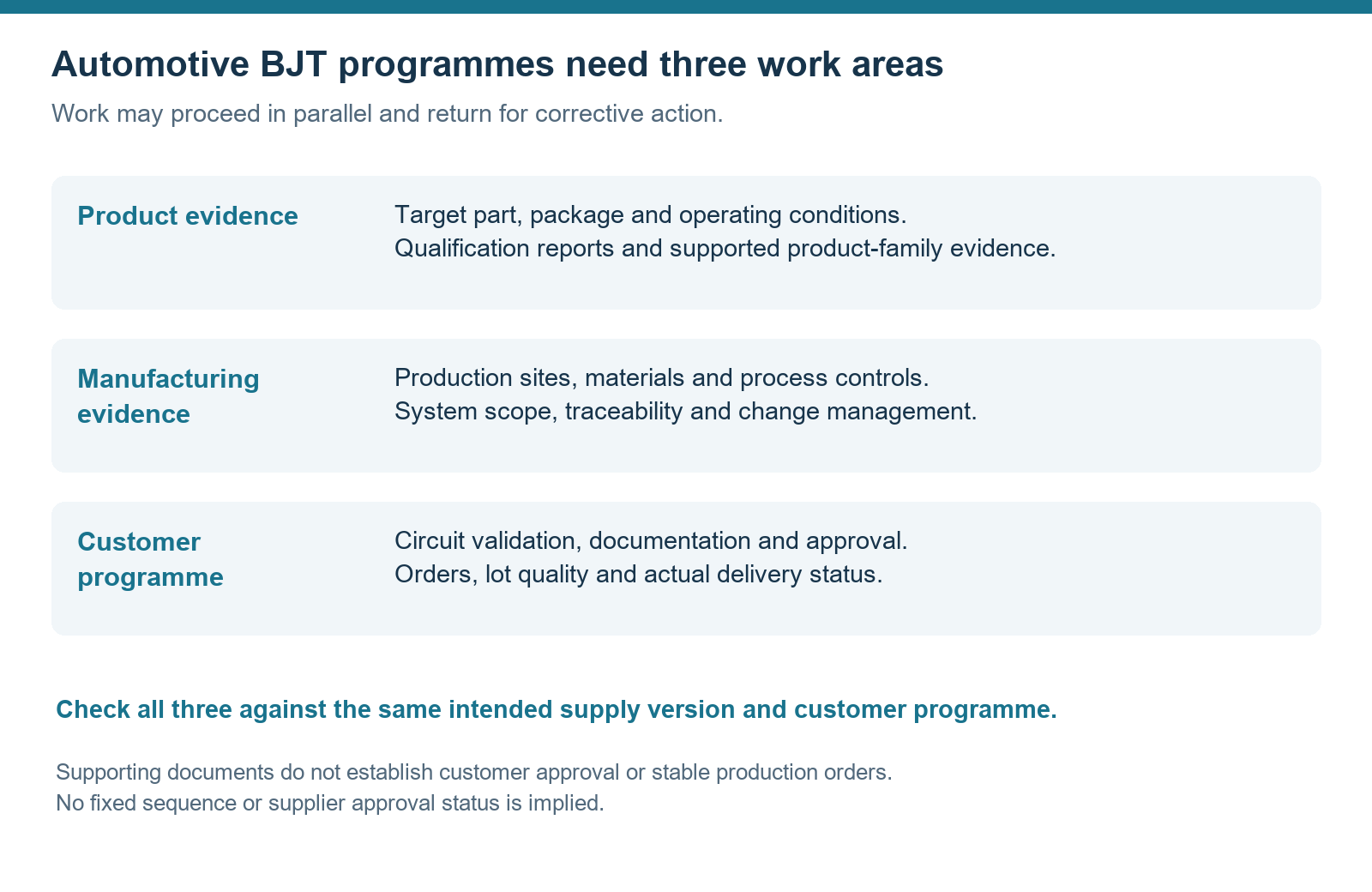
Figure 3. Product, manufacturing and customer work can proceed in parallel and return for corrective action. This explanatory diagram prescribes no single sequence and indicates no supplier's approval status.
AEC-Q101 addresses discrete-device reliability qualification, IATF 16949 addresses automotive manufacturing quality-management systems, and PPAP concerns production-part approval. AEC documentation also distinguishes product qualification from approval for a customer's application. These requirements must be connected to the applicable product, process and customer; their names alone say nothing about order volume.
Financial returns depend on profit, cash collection and reusable project work
Galaxy Microelectronics reported approximately RMB 1.010 billion in revenue for January–September 2026, up 35.65% year on year. Net profit attributable to shareholders was approximately RMB 97.08 million, up 109.70%, and net cash from operating activities was approximately RMB 111.87 million. These company-level results indicate stronger overall operating performance, without separately identifying automotive BJT contributions.
Galaxy's third-quarter report also explains that, alongside downstream demand, product mix and cost control, lower interest expense following convertible-bond conversion and redemption affected profit in the quarter. Faster profit growth than revenue cannot be attributed entirely to higher-value products. Product performance, financing expenses and cash collection need separate consideration.
Blue Rocket Electronics reported approximately RMB 690.44 million in revenue, RMB 17.89 million in attributable net profit and RMB 84.77 million in operating cash flow for the same nine-month period. Its report also describes acquisitions and newly controlled entities entering the consolidated accounts. Changes in consolidation scope must be considered when assessing growth. Differences in business model and product mix prevent a direct inference about transistor technology from the two companies' profit totals.

Figure 4. Company consolidated figures from the two 2026 third-quarter reports, expressed in RMB million. These are not BJT revenue or profit figures. Blue Rocket's consolidation scope changed. Rounded figures are shown consistently in one unit.
Assembly and test profitability depends on utilisation, product mix, processing costs and equipment investment. IDMs must also manage costs across wafer fabrication and packaging. Automotive programmes can incur testing, failure-analysis, customer-support and documentation expenses before orders are large enough to spread those costs efficiently.
Repeatable project work can improve the economics. Supported product-family evidence and established manufacturing or quality systems may reduce duplicated work in subsequent programmes. The scope for reuse depends on product differences and customer acceptance; it does not remove necessary validation.
Diversified companies such as Good-Ark require another separation between semiconductor and other businesses. Its first-half report distinguishes semiconductors from new materials, so total company revenue cannot represent the transistor market. Where BJT revenue and gross margin are not disclosed separately, customer programmes, delivery quality and capacity utilisation offer firmer evidence than an invented automotive margin estimate.
China's automotive BJT landscape already includes distinct device-supply, manufacturing, testing and assembly roles. Competition now turns on specific product suitability, controlled manufacturing and sustained delivery. JSCJ and Galaxy need to turn their portfolios and manufacturing capabilities into further verifiable programmes; Jilin Sino-Microelectronics' testing capabilities need to support product development; assembly and test providers must demonstrate qualified output and effective customer support. Repeating these tasks across programmes is what can turn an initial adoption into a continuing business.
Based on public disclosures. For industry discussion only; not an investment, procurement or part-selection recommendation.