
Smartphone and wearable inductors: miniaturisation and Chinese supplier progress
Phones, earbuds, watches and AI glasses are adding processing, connectivity and sensing within limited space. Batteries, antennas, cameras and power circuits compete for that space, requiring smaller inductors without sacrificing signal quality or supply efficiency. In products worn against the body, heat and battery life also affect the user experience.
Chinese suppliers address these needs through multilayer, wirewound and moulded products, supported by materials development and custom manufacturing. For international buyers, the relevant comparison combines circuit function, process choice and commercialisation stage. A minimum package size or application list cannot establish all three.
Footprint reduction and lower height are different design goals
TAIYO YUDEN's April 30, 2026 expansion of the LSCN series targets smartphones, smartwatches and true-wireless earbuds. The LSCND0805FET1R2MJ measures 0.8 × 0.45 × 0.65 mm, with height stated as a maximum. The announcement compares it with the series' previous minimum dimensions of 1.0 × 0.5 × 0.33 mm and describes an approximately 30% reduction in occupied area.
Multiplying length by width gives 0.36 versus 0.50 mm², a 28% reduction. Height, however, increases from 0.33 to 0.65 mm. This is a smaller footprint with a taller outline, not evidence of a direct replacement at equal inductance and current.
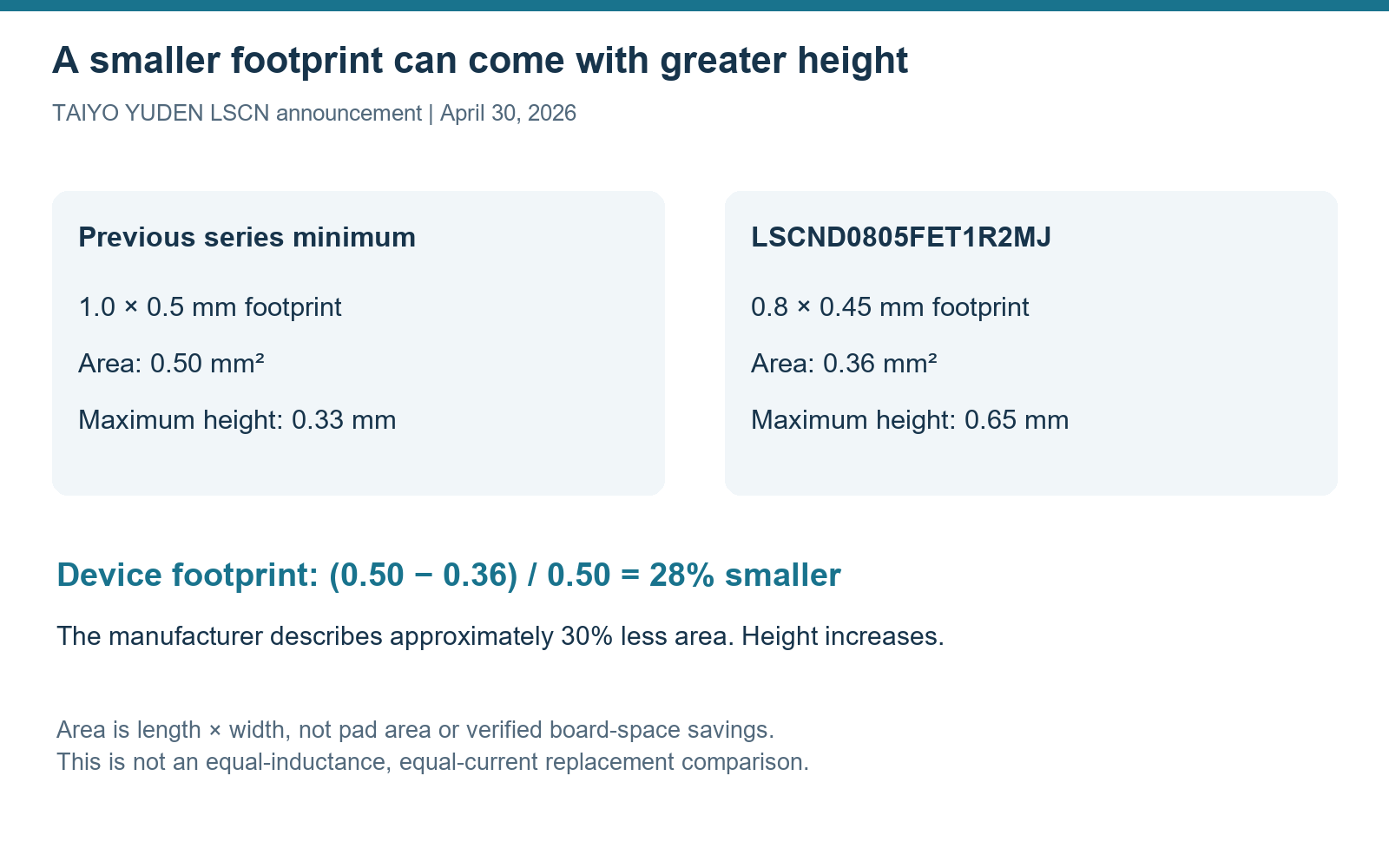
Figure 1. Calculated from the dimensions in TAIYO YUDEN's April 30, 2026 announcement. Area means device length × width, not land-pattern area or verified space saved on an assembled board. Heights are stated maxima.
An earbud with available vertical space may benefit from the smaller footprint. An ultrathin phone or glasses arm may instead be height-constrained. Pads, surrounding clearances and thermal conditions also determine the actual board-space benefit.
Package codes require care: “0402” can mean 0.4 × 0.2 mm in a metric system or 1.0 × 0.5 mm in an imperial system. Comparisons should state millimetre dimensions, maximum height and tolerances. Footprint, thickness and performance per unit volume are separate questions.
More device functions do not translate mechanically into more inductors. New power rails and matching networks may add parts, while module integration may combine functions. Opportunities include both new part numbers and improvements in thickness, loss and current capability. An inductor suited to an earbud's space or light-load supply may not suit a thin phone or a processor's startup transient. Suppliers need product families around actual circuits.
RF performance and portfolio support shape supplier competition
RF inductors participate in antenna matching and filtering. Equal nominal inductance does not imply equal inductance, Q or parasitic behaviour at the operating frequency. Q relates reactance to loss and must be compared at the stated frequency and inductance. Self-resonant frequency helps describe parasitic effects, but selection still requires curves around the target band.
Fenghua Advanced Technology's first-half 2026 report groups its inductors into multilayer, power and wirewound products. Multilayer offerings include high-frequency, bead and ferrite products; wirewound offerings include FHW, FHD and common-mode filters. These serve different purposes: signal processing, noise suppression and power conversion require different performance criteria.

Figure 2. Original excerpt from Fenghua's first-half 2026 report, preserved in Chinese. Reading guide: the three rows cover multilayer, power and wirewound inductors. The table describes business scope, not universal smartphone use or a customer's bill of materials.
Fenghua also operates electronic-material and other passive-component businesses. Its report describes continued development of ceramic powders and copper, nickel and silver pastes. Materials, conductors and structures must work with manufacturing processes in miniature devices, where changes affect performance distributions. A broad platform supports joint development; gains still need to be demonstrated for individual specifications and production lots.
Microgate Technology's first-half report lists smartphones and communication modules among multilayer chip-inductor applications and describes improvements in ceramic formulations and processing. This route differs from its power wirewound and moulded products, illustrating expansion by circuit function rather than simply more power-inductor capacity.
Portfolio breadth can also improve customer-development efficiency. Phones, earbuds and glasses contain several communication and power circuits, allowing one supplier to participate in more component evaluations. Each part still requires board-level checks of tolerance, frequency behaviour and interactions with adjacent components. Likewise, SAW or LTCC filter business may create customer contact, but RF-filter standing cannot be counted as RF-inductor market share.
Mobile power supplies support several manufacturing routes
In DC-DC circuits, DC resistance affects conduction loss, while core and conductor structures affect AC losses. Inductance change under load and temperature rise determine usable operating conditions. These trade-offs allow wirewound, moulded and multilayer power inductors to coexist.
Microgate's first-half 2026 report describes continuing stable supply of miniature flat-copper-wire inductors to consumer-electronics manufacturers. It also reports iterations of moulded families including MPSM-BV and MPSM-VJ, targeting flagship phones and AR or AI glasses power supplies. The first disclosure concerns continuing supply; the second concerns product development and intended applications. They should not be assigned the same adoption stage.
Wirewound designs balance conductor cross-section, winding geometry and magnetic space. Moulded devices must coordinate magnetic materials, insulation and forming pressure. Different height, temperature-rise and noise requirements in phones and glasses encourage further product variation within each platform.

Figure 3. Original row from Microgate's first-half 2026 report. Reading guide: the columns identify multilayer chip inductors, the manufacturer's stated monolithic-structure and precision characteristics, applications including phones and communication modules, and product images. These application categories identify neither an end-product model nor shipment share.
Sunlord's MPF series, announced in September, provides a multilayer alloy power-inductor example. The manufacturer states that it is in mass production, targets DC-DC and RF power-amplifier supplies in phones and wearables, and has a minimum footprint of 1.0 × 0.5 mm. Materials and multilayer printing extend small power-device options. Supplying an RF power amplifier is a power function, distinct from RF signal matching; mass production does not establish adoption in every target device.
Guangdong Wanci Technology's official exhibitor profile lists moulded surface-mount inductors and insulating materials for inductors. Insulation separates conductors electrically from magnetic materials and contributes to manufacturing reliability. The available information does not establish miniature-part performance or volume use in a particular wearable, so it cannot support a high-end market ranking.
Jinlai Technology offers moulded and wirewound power inductors, transformers and other magnetics, including non-standard power-inductor customisation. Standard coverage and custom manufacturing address different combinations of shape, mounting and current requirements. Capacity for other magnetic components should not be counted as miniature-inductor supply capability.
Yuechen Technology, formerly Cenker, distinguishes consumer X-series and automotive A-series products across power, high-frequency, common-mode and transformer categories. That positioning helps identify intended markets. Mobile applications still require corresponding size, loss and validation evidence; automotive progress cannot be transferred to phones or glasses.
These companies combine platform breadth, materials support, standard products and custom work in different ways. Public disclosure also varies. Product iterations and supply progress can be recognised without inventing undisclosed customers, specifications or shares.
Light-load efficiency, production consistency and validation affect returns
Wearables operate across standby, audio processing, imaging and wireless-transmission loads. One efficiency point at high current cannot represent a complete usage cycle. TDK's September 2026 PLE-series material emphasises AC resistance, low-loss materials and leakage-flux control in discussing small-battery devices.
Current ratings also depend on their criteria. Saturation current relates to inductance decline; temperature-rise current relates to heating. They are not interchangeable. Enclosure temperature, PCB heat dissipation and neighbouring heat sources affect actual operation. Reduced material use must be weighed against losses, thermal management and assembly conditions.
Miniature manufacturing requires control of layer registration, conductor patterns, forming dimensions and terminations. Added inspection, screening and rejects can change unit cost. A successful sample must be reproduced across successive lots.
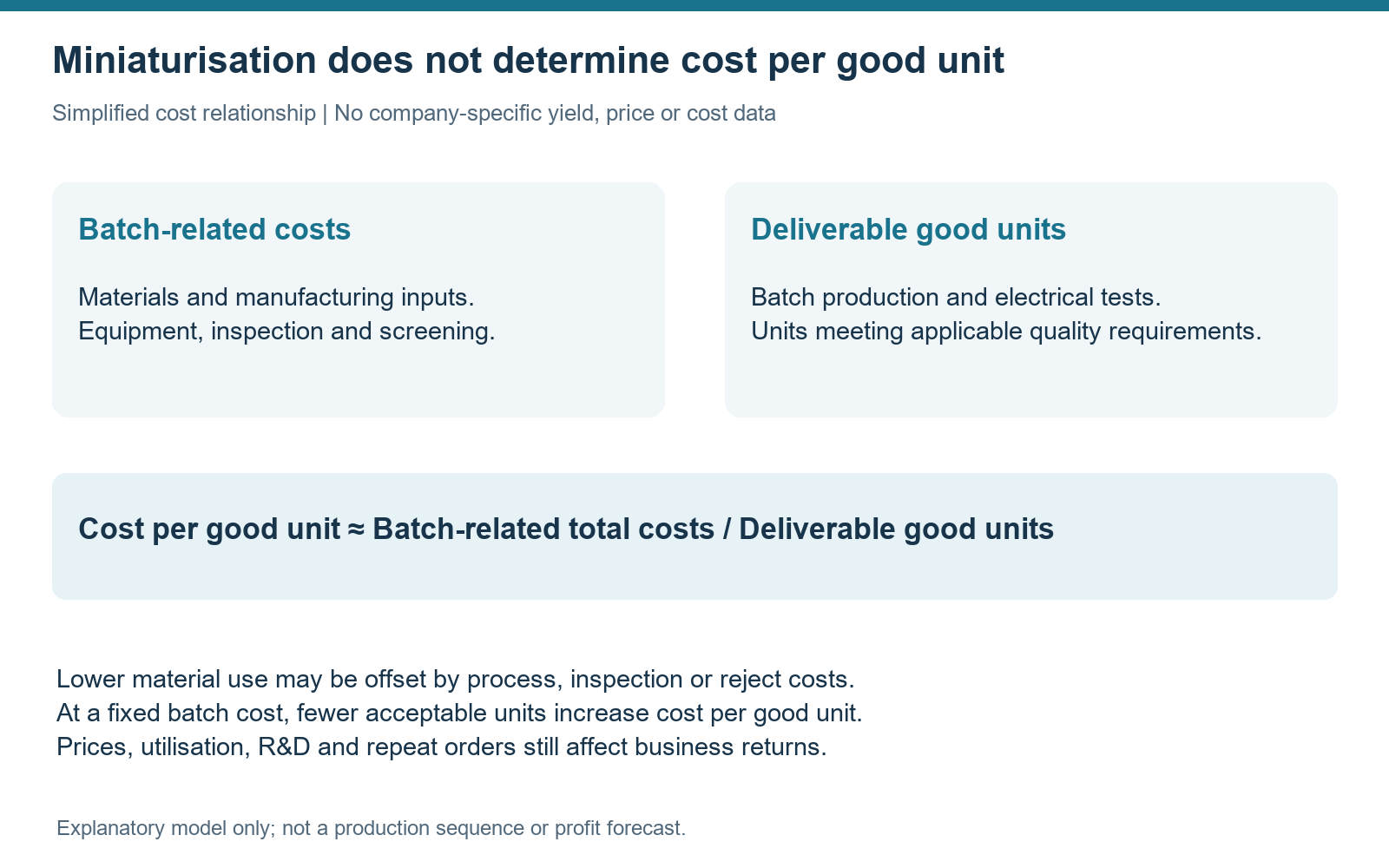
Figure 4. A simplified cost relationship, with no company-specific yield, price or cost inputs. It does not prescribe a universal manufacturing sequence.
Customer validation is another investment. RF parts require matching, loss and transmit/receive checks; power parts require efficiency, ripple, transient and temperature-rise checks. Murata's technical materials from the preceding year illustrate characteristic viewers, simulation models and circuit-comparison tools. These can reduce initial selection work, while final board validation remains necessary.
Financial conclusions must respect product boundaries. Microgate's electronic-components business recorded a 22.88% gross margin in the first half of 2026, up 1.76 percentage points year on year. The segment includes several products, so the improvement cannot be attributed solely to miniature phone inductors. Product counts, factory size and application lists likewise cannot establish undisclosed revenue or profit.
Mobile and wearable opportunities arise within specific space, frequency and load constraints. Chinese suppliers already offer several routes, while international manufacturers continue to improve size, losses and design support. Sustained competition depends on delivering appropriate performance consistently, at a cost that supports manufacturing and customer validation.