
EV Power Semiconductors: China's Supplier Progress Across 800 V Platforms and Low-Voltage Electronics
For engineering and sourcing teams evaluating Chinese EV semiconductor suppliers, an 800 V platform label reveals only part of the opportunity. Traction batteries, motor drives, charging systems, cameras and cockpit processors operate at different voltage levels and require different combinations of power devices, drivers and regulators.
StarPower's power modules, NOVOSENSE's isolated drivers and the low-voltage products of Southchip, JoulWatt and SCT consequently enter vehicles through different design positions. Disclosures published in 2026 show progress across these areas, but at different stages. Higher traction voltage changes some component requirements; additional vehicle electronics creates a separate source of power-management demand.
An 800 V architecture changes high-voltage requirements without defining every power rail
The on-board charger, or OBC, converts external AC power into DC suitable for charging the traction battery. During DC fast charging, the main conversion takes place in equipment outside the vehicle, and charging current normally bypasses the OBC's main AC-conversion power path. A higher vehicle DC charging rating therefore does not automatically imply a higher OBC rating.
A separate path supplies low-voltage loads. The high-voltage-to-low-voltage DC-DC module converts traction-battery voltage for the vehicle's low-voltage network. Inside electronic control units, board-level DC-DC converters, LDOs and PMICs then power processors, sensors and interfaces. These board-level ICs and the high-voltage converter differ in power level, voltage requirements and isolation responsibilities.
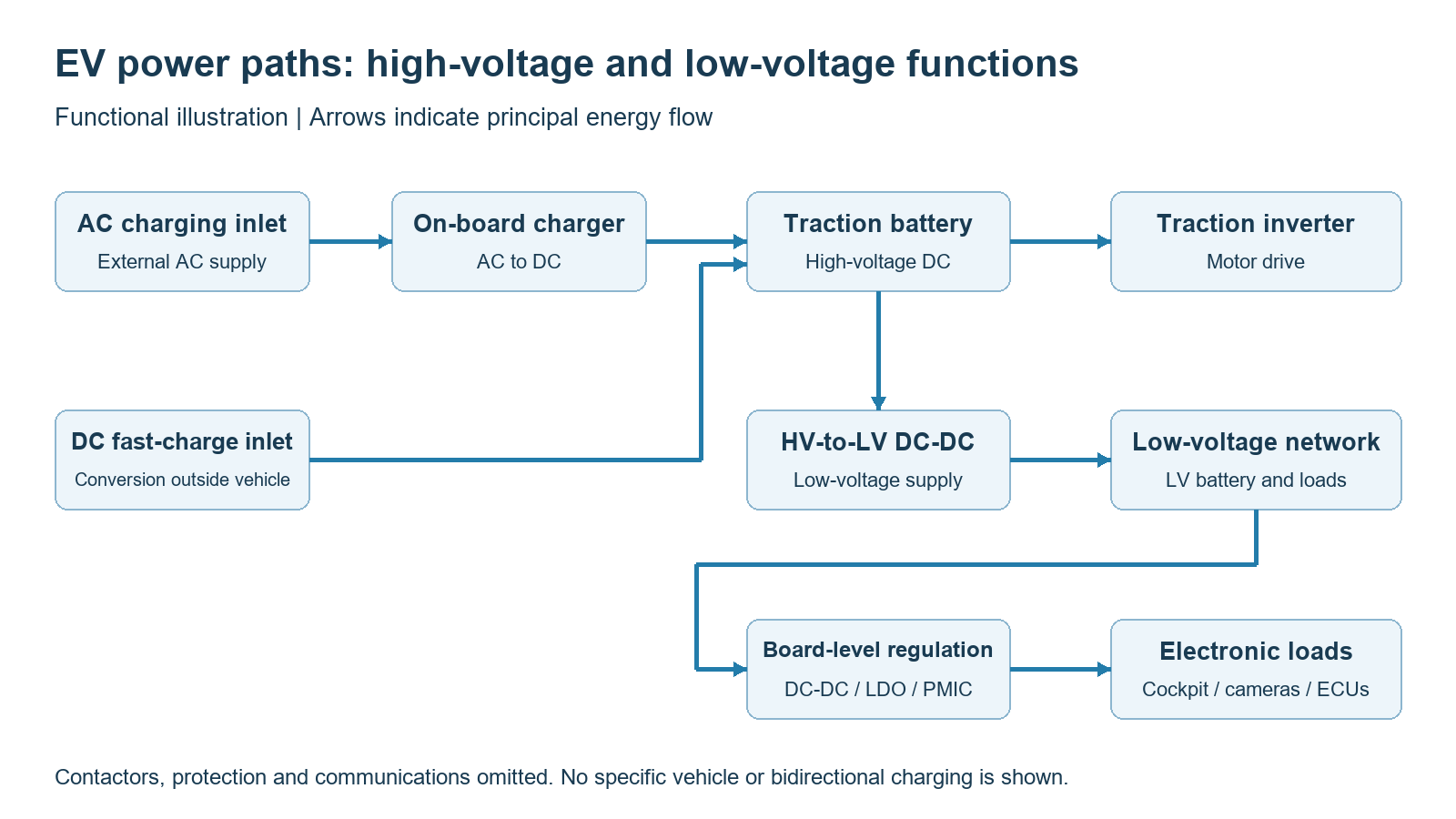
Figure 1. Principal EV power paths. This functional illustration omits contactors, protection and communications. It does not represent a particular vehicle or show bidirectional charging.
Raising platform voltage reduces current at a given power. Ignoring losses, transferring 200 kW requires 500 A at 400 V or 250 A at 800 V. For unchanged wiring resistance, conduction loss varies with the square of current. Actual vehicle efficiency also depends on operating voltage, device losses, wiring and thermal management; the ideal calculation cannot be converted directly into a range improvement.
Higher voltage also changes insulation, blocking-voltage and protection requirements. Battery voltage varies with operating state, and switching can introduce transient overshoot. Device selection must account for maximum operating voltage, topology and design margin. Matching a device rating numerically to the platform label is insufficient.
High-voltage development, isolated drivers and traction modules are at different stages
In OBCs, traction inverters and high-voltage DC-DC converters, power devices perform energy conversion while driver ICs control switching. SiC can support higher-frequency, higher-efficiency designs, but faster switching also increases the importance of parasitics, voltage spikes and interference. Drive strength, protection response and layout need to be considered together.
Chipown's first-half 2026 report describes a high-voltage EV power and electric-drive IC project targeting 400 V and 800 V battery systems, including OBCs, power distribution units and electric drives. The project remained in ongoing R&D. It establishes a development direction rather than volume production of the entire proposed portfolio.
Isolated drivers must also transfer control signals between different electrical potentials. Peak drive current, common-mode transient immunity, propagation delay and protection functions address different requirements: charging and discharging the gate, avoiding false switching during rapid voltage transitions, coordinating switches and shutting down correctly during faults. A single specification cannot establish suitability for the complete circuit.
NOVOSENSE's first-half 2026 report says its new single- and dual-channel isolated drivers developed for SiC devices entered volume production and achieved substantial shipments into automotive OBCs, charging stations and photovoltaic inverters. This places those products beyond technical introduction and into supply across several conversion applications.
The same report distinguishes between generations of functional-safety drivers. First-generation products were shipping at scale, while second-generation isolated gate drivers had begun OEM sample testing and secured multiple project nominations. The next generation's nominations should not be merged with the shipment status of existing products.

Figure 2. Original Chinese-language excerpt from page 20 of NOVOSENSE's 2026 interim report, preserved as documentary evidence. The relevant disclosure distinguishes volume shipments of SiC isolated drivers and first-generation functional-safety drivers from sampling and project nominations for the second generation. This is an official-document screenshot.
3PEAK is also expanding gate drivers. Its interim report describes new isolated gate drivers using its own capacitive-isolation process and general-purpose gate drivers with Miller clamps, with new-energy vehicles among the target applications. The disclosure does not quantify automotive volume shipments of these newly introduced devices.
StarPower's progress concerns power chips and modules. It reported continued high-volume shipments of modules using its own second-generation 750 V and 1200 V automotive SiC MOSFET chips for 400 V and 800 V traction-platform projects. Automotive three-level SiC modules had secured several project nominations, with volume production expected in 2027. Existing-platform shipments and new-topology nominations remain separate milestones.
Traction-module progress demonstrates participation in high-voltage propulsion, but does not measure OBC power-management IC market share. NOVOSENSE and StarPower illustrate complementary component functions; the disclosures cited here do not establish that they supply the same customer design.
Cameras, cockpits and driver assistance expand low-voltage power demand
Moving to a high-voltage traction platform does not connect cameras or cockpit processors directly to that voltage. These loads need multiple rails, low noise or high current at board level. Sequencing, fault monitoring and standby consumption also affect system operation. Demand here follows electronic functionality rather than traction voltage alone.
Southchip's first-half 2026 report identifies body control, cockpit electronics and intelligent driving as automotive development areas. Its portfolio includes buck-boost DC-DC devices, LDOs, intelligent high- and low-side switches, e-fuses and ADAS power solutions. This extends its role from generating supply voltages to managing current paths and abnormal conditions.
SG Micro lists new automotive products including a 65 V ultra-low-power buck controller, an ultra-low-power high-PSRR LDO, a four-channel camera PMIC and a 7 mΩ high-side driver. They address conversion, regulation, camera power and load control. The 65 V specification belongs to the buck controller and cannot be compared directly with the vehicle's 800 V architecture. A product introduction also does not establish production installation in a named vehicle.
JoulWatt reported multiple ASIL-D PMICs for intelligent driving and cockpit applications, together with an automotive 90 A DrMOS and a four-phase controller. Its automotive multiphase products had entered multiple customers. These products power vehicle computing loads rather than converting traction-battery energy for the motor.
SCT's SCT61250S, introduced in July 2026, illustrates camera-power integration. It accepts a 4–19 V input and integrates three DC-DC converters and two LDOs. Combining switching and linear regulation provides multiple rails within a small area, with efficiency, noise and layout among the design considerations.

Figure 3. Functional illustration based on SCT's July 2026 product introduction. It shows three DC-DC channels and two LDO channels without assigning individual rails to a particular image sensor or serializer.
SCT also reported ASIL-B product certification for the SCT61250S series. Product certification informs customer evaluation, while the camera project's safety goals, diagnostics and system validation still require completion. Certification of a supplier's functional-safety management system is a different level of evidence from certification of a specific product.
Cameras and body-control units also need to switch individual loads. 3PEAK reported volume production of several automotive multichannel high-side switches for applications including ADAS camera power and body control. A high-side switch manages the load's supply path, whereas a multi-rail PMIC provides regulated voltages. The two can occupy different positions in the same system.
Topology, manufacturing and customer programmes determine commercial value
A high-voltage platform does not require the same semiconductor material in every circuit. Input/output range, frequency, power, cooling and cost influence the choice of silicon, SiC or GaN and the associated drivers. Adoption in a traction inverter does not establish equivalent economics in an OBC, low-voltage supply or protection circuit.
Oriental Semiconductor's first-half 2026 report provides a manufacturing-development example. A project involving 1200 V SiC power devices completed a new-generation tape-out and met its static-parameter targets. This demonstrates platform development, but does not replace dynamic-switching, reliability, packaging and customer-system validation or establish automotive volume supply.
Overseas product development also shows competition extending into topology and packaging. In June 2026, Infineon introduced a bidirectional switch based on 750 V CoolSiC G2 technology, integrating two power switches in a top-side-cooled Q-DPAK package. Single-stage OBCs were among its target applications, and the announcement stated that sampling had begun.

Figure 4. Infineon's official rendering of its 750 V CoolSiC G2 bidirectional switch, introduced in June 2026. It illustrates the bidirectional-switch and top-side-cooling direction; it does not establish suitability for every 800 V circuit.
OBC improvements can therefore involve switch combinations, conversion-stage count and cooling paths together. Chinese suppliers need both competitive devices and sufficiently complete reference designs, protection configurations and test information for customers to evaluate the resulting module.
Customer programmes determine when technical progress becomes revenue. Testing subjects a device to a particular system's conditions. A project nomination establishes a supply arrangement for that programme, but subsequent business still depends on vehicle production, programme timing and procurement volume. Products already shipping and newly nominated projects should be assessed separately.
Financial reporting requires similar care. NOVOSENSE's automotive business includes sensors, signal-chain products and power management. StarPower's new-energy business also includes renewable-power-generation applications. Treating either broad category as “800 V power-chip revenue” would mix component functions and end markets. Disclosures tied to specific applications, product generations and supply stages offer a more useful basis for evaluating supplier progress.
Chinese EV semiconductor opportunities are developing across high-voltage conversion, isolated driving and low-voltage electronics. Some products have reached volume supply; others remain at tape-out, validation or nomination. The next evidence to track is adoption on production platforms, broader component coverage and revenue attributable to those applications, beyond the vehicle's headline voltage rating.