
Two very different capacitor formats perform different jobs inside an AI-server power system: high-voltage snap-in aluminum electrolytics rated around 450 V, and compact surface-mount capacitors designed for low-voltage rails. Their size and specifications are far apart, yet both are necessary for stable power delivery.
Jianghai's August 2026 interim report disclosed a new capacity plan. The company is building and upgrading automated lines for data-center snap-in capacitors while accelerating technology and capacity expansion for polymer-hybrid aluminum electrolytics and multilayer polymer capacitors, or MLPCs.
This is not a bet on one universal "AI capacitor." High-power server architectures need different technologies for bulk energy storage, ripple filtering and fast load response at different voltage levels. The central question is whether China-based capacitor suppliers now have the reliability evidence and production discipline required for broad server-BOM adoption.
1. Why snap-in aluminum electrolytics come first
Jianghai reported first-half 2026 revenue of RMB 3.151 billion, up 16.96% year on year. Traditional aluminum electrolytics contributed RMB 2.498 billion and remain the company's core business. Compared with its smaller MLPC and hybrid-capacitor operations, the technically mature and broadly applicable snap-in product is the most direct route to meaningful volume.
The familiar snap-in aluminum electrolytic takes its name from the formed terminals that lock into a PCB. In a server AC-DC supply, rectification and power-factor correction create a DC bus at several hundred volts. Snap-in capacitors provide bulk bus energy storage, suppress low-frequency ripple and maintain output briefly after input power is removed.
As AI-server power rises, the component faces higher ripple current and more demanding hold-up-time requirements. Increasing capacitance alone is not enough. ESR, internal temperature rise, lifetime, airflow and mechanical volume must be considered together. High-voltage, high-capacitance, long-life snap-in devices are therefore among the BOM categories that server-power manufacturers most urgently need to qualify at greater volume.
Jianghai had previously announced volume orders for server capacitors. The interim report adds evidence that its data-center snap-in line is being upgraded. Public information still does not identify the end customer, order size or dedicated data-center part numbers. Commercial deployment is real, but it is too early to describe Jianghai as a leading-volume supplier to the entire sector.
2. Three capacitor technologies, three positions in the power chain
Server filtering and energy storage behave more like a layered reservoir system than a single component choice.
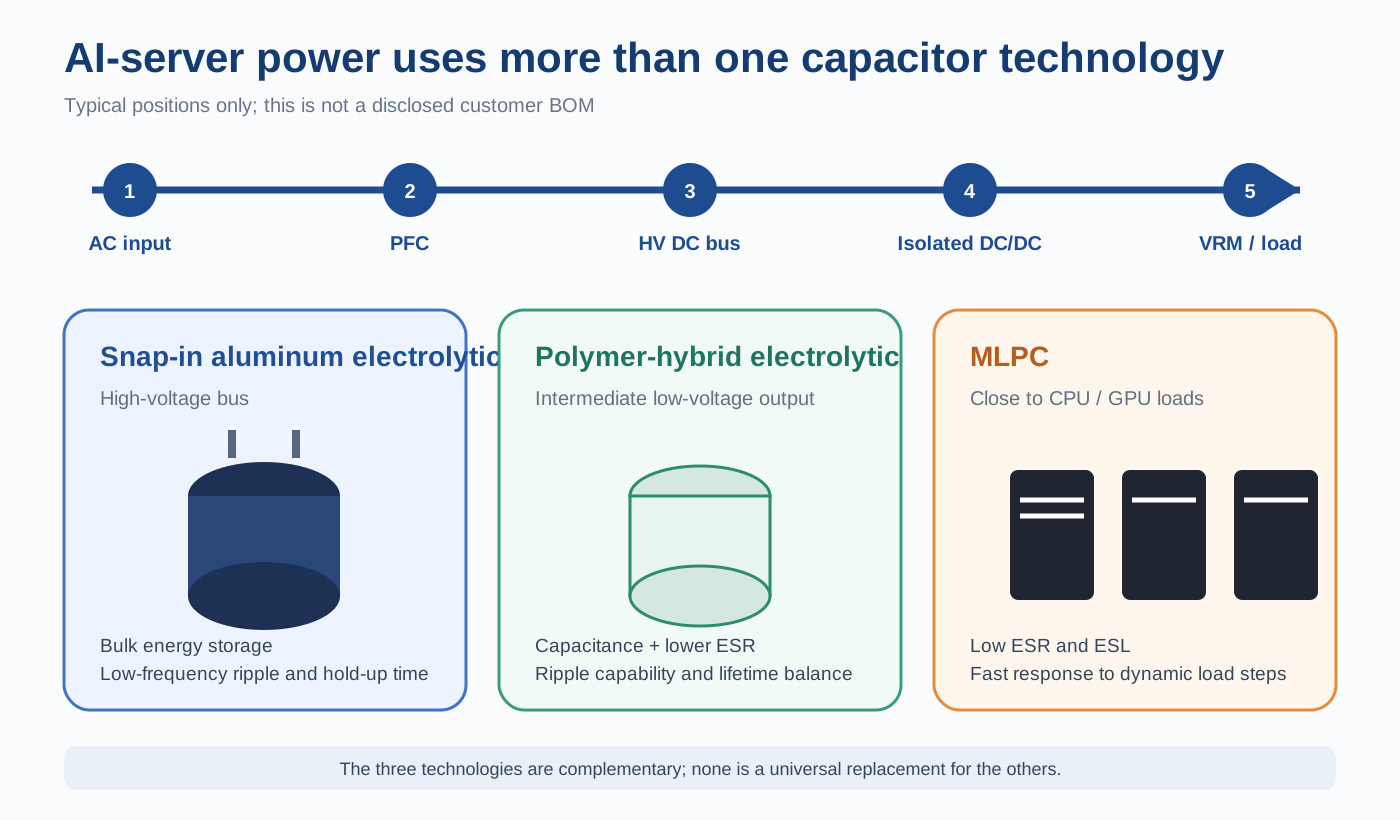
At the high-voltage bus, a snap-in aluminum electrolytic provides the large capacitance and voltage rating needed for bulk storage and low-frequency stabilization. After DC/DC conversion lowers the voltage and raises the current, capacitor priorities shift toward high-frequency filtering, ripple suppression and fast response to CPU or GPU load steps.
Polymer-hybrid aluminum electrolytics combine a liquid electrolyte with conductive polymer. The technology balances capacitance, low ESR, ripple capability and long-term reliability and is well suited to low-voltage, high-current, high-temperature power supplies in communications and data-center equipment. Jianghai has not yet published a complete data-center hybrid series or confirmed design-specific BOM details.
MLPCs use a multilayer polymer structure to reduce ESR and ESL for low-voltage, high-current, high-transient loads. Jianghai's HPA family spans 2 V to 25 V and 6.8 uF to 560 uF and can be used around DC/DC converters, switch-mode power supplies and processor-support rails.
These technologies are complementary rather than interchangeable. Snap-in devices provide bulk energy storage, polymer-hybrid devices balance performance and lifetime, and MLPCs sit closer to the load for rapid transient response.
3. Meeting the headline specification is only the entrance test
Many China-made capacitors now approach international competitors on basic published parameters. The more difficult part of supplier substitution is stable behavior over years of complex data-center operation.
Snap-in qualification is demanding. Capacitance and rated voltage are only baseline values. Ripple-current capability must be derated for operating frequency, ambient temperature, airflow and target system life. Two parts with similar appearance and dimensions can produce very different full-load temperatures because of internal construction, ESR and thermal resistance, directly changing expected service life.
MLPC and hybrid devices cannot be selected on "low ESR" alone. Before use in a server supply, they need surge-current, ripple-voltage, reflow, temperature-humidity, mechanical-stress and lot-consistency testing. Their transient response must also be checked against real processor load steps. Small changes in copper impedance, layout or loop design can erase an apparent component-level advantage.
Jianghai's HPA family is a mature catalog range, but public material does not identify the voltage, capacitance, package and reliability grades dedicated to specific server programs. Until customer-qualified part numbers are confirmed, the family should not be described as a standardized drop-in replacement for server designs.
Procurement may focus on price, while engineering carries the implementation cost: prototype debugging, thermal testing, EMC correction, lifetime estimation and production-line changeover. A successful move to a China-based source is a system capability that includes validation, delivery and risk control—not a comparison of data-sheet rows.
Conclusion
Jianghai's expansion of data-center snap-in capacity and its parallel work on hybrid capacitors and MLPCs show that AI-server demand is moving from market narrative to physical manufacturing investment. The opportunity is not one capacitor part number; it is a structural change across the power BOM.
The status labels still matter: capacity expansion is not the same as qualified volume production, and a volume order is not proof of stable, industry-wide supply.
Snap-in aluminum electrolytics are Jianghai's most direct path into high-power AI-server supplies. MLPCs are the strategic route closer to CPU and GPU loads. Future design wins will depend less on installed capacity than on long-duration reliability evidence, production consistency, complete technical documentation and dependable delivery.
Capacity sets the supply ceiling. Validation determines whether a component is allowed into the design.
Disclaimer: This article is based on public information and is for industry discussion only. It is not investment, procurement or part-selection advice. Confirm specifications, orders, customer relationships and supply status with the manufacturer, customer and authorized channel.