Tantalum Capacitors for Servers and Enterprise SSDs: Low-Profile Options and Progress from Chinese Suppliers
For storage designers evaluating Chinese tantalum capacitors, available board space and the supplier's qualification stage matter as much as nominal capacitance. Micron reported shipments of a high-speed SSD for AI-inference KV caching in September 2026. In October, Kioxia introduced an E1.L SSD for high-density 1U servers and began sampling to selected customers. More storage in a constrained enclosure also puts pressure on the space available for energy-storage capacitors.
Tantalum capacitors can support transient voltage regulation on server boards and provide stored energy for enterprise SSD power-loss protection. Chinese suppliers have disclosed low-profile products and customer-validation progress. Assessing their commercial significance requires separating those two circuit functions, the delivery milestones and the revenue actually reported.
Server transients and SSD power loss require different validation
When a CPU, accelerator or network adapter suddenly draws more current, its buck regulator takes time to respond. Output capacitors initially supply the difference, limiting voltage droop. Designers combine technologies according to frequency and layout: MLCCs can provide high-frequency decoupling near the load, while polymer tantalum or polymer aluminium capacitors can provide bulk capacitance where appropriate. Trace inductance, distance from the load and the regulator control loop influence the result.
SSD power-loss protection has a different objective. A capacitor bank charges during normal operation. When external power fails, the protection circuitry changes the supply path so the controller and flash can operate briefly and complete critical data and mapping-information writes according to firmware policy. Micron's September 2026 specifications for the 6600 ION list enterprise power-loss protection and a 12 V main supply. A capacitor bank on a boosted storage node must be rated for that node's actual design conditions; the interface supply voltage does not determine the capacitor rating.
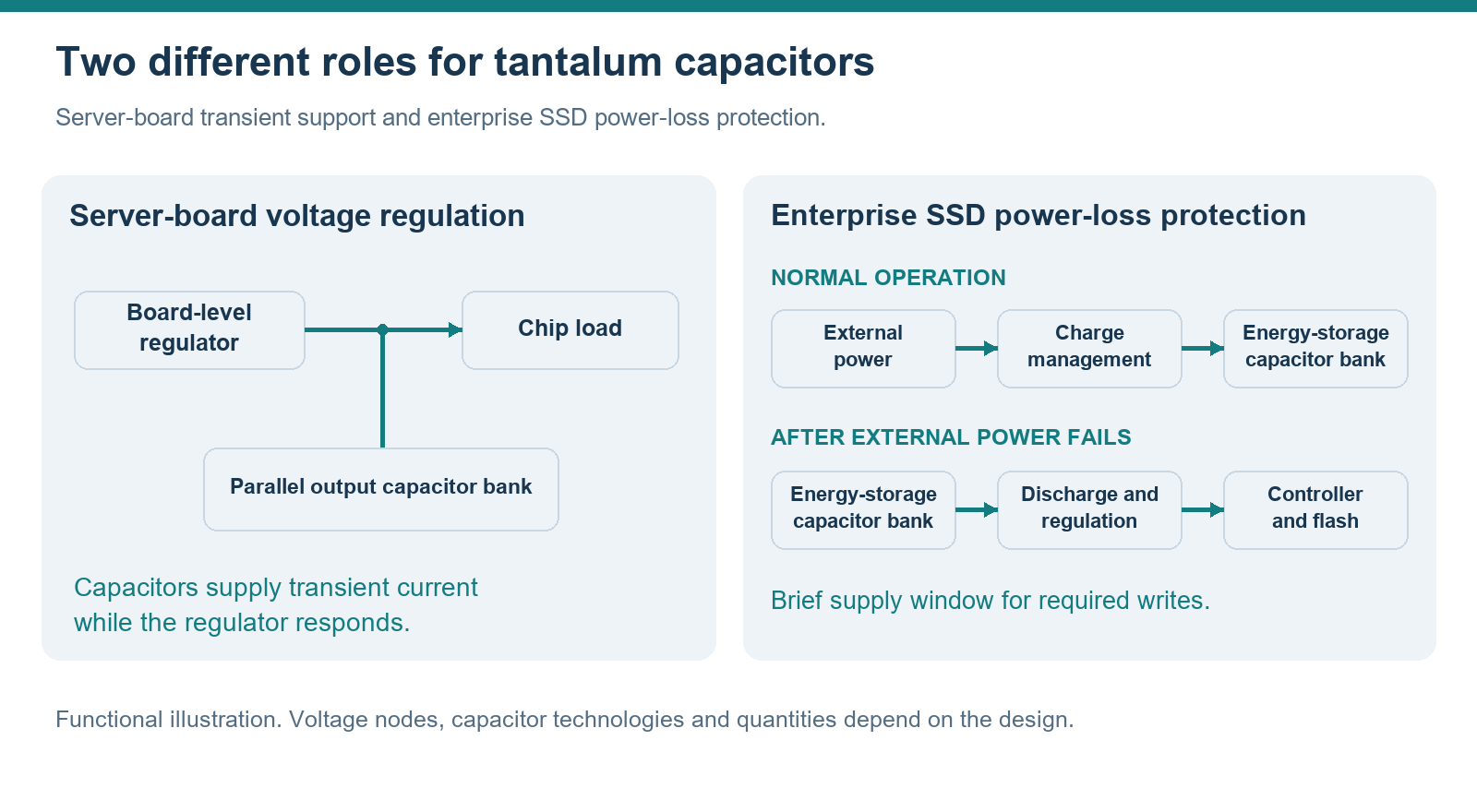
Figure 1. Functional comparison of server-board transient support and enterprise SSD power-loss protection. The paths illustrate operating principles, not a customer circuit or BOM.
Usable energy is the energy released between the charged voltage and the downstream converter's minimum operating voltage. ESR adds voltage drop during a current step; temperature, ageing and conversion losses consume further margin. Equal nominal capacitance can therefore produce different hold-up times on different boards.
For an ideal capacitor discharged from 28 V to 18 V, usable energy is approximately 59% of the energy stored at 28 V. A higher converter cutoff reduces that fraction. Selecting a 35 V-rated capacitor still requires calculations using the actual charge and cutoff voltages and worst-case operating conditions. Server validation emphasizes droop and recovery; SSD validation must also show that required writes finish in time.
Low-profile storage trades height against footprint and parallel count
Controllers, flash, connectors and cooling components compete for space on a thin SSD. A thinner capacitor can recover capacitance through a wider package, a different tantalum-anode structure or additional parallel devices. Those choices affect footprint, pad layout and startup charging current.
YMIN's August 2026 polymer tantalum catalogue illustrates the trade-off. At 35 V, it lists TQD15 options at 47 μF and 1.5 mm nominal height, TQD19 at 68 μF and 1.9 mm, and TQW19 at 100 μF and 1.9 mm. The latter two share a height, but width increases from 4.3 mm to 6.0 mm for TQW19. A board with lateral room may accommodate more capacitance per device; a design constrained in both height and area needs a fresh calculation of parallel count, available energy and routing.

Figure 2. Series illustrations from YMIN's August 2026 manufacturer catalogue. They identify product families; electrical and dimensional specifications belong to the corresponding selection pages.
SSD designs with more room may also use hybrid aluminium electrolytic capacitors. YMIN's enterprise SSD application material includes both technologies. Capacitor demand depends on the information to be protected, downstream load and power architecture. Growing data-centre SSD shipments expand the application opportunity, while the share captured by polymer tantalum depends on drive formats and competing solutions at the same circuit position.
Chinese supplier disclosures span qualification, validation and trial production
Hongda Electronics says it has qualified as a tantalum-capacitor supplier to several leading Chinese server and SSD manufacturers. Its portfolio includes metal-cased, high-energy hybrid and polymer tantalum products; subsidiary Xiangyi Electronics develops and manufactures chip tantalum capacitors. Supplier qualification confirms passage through relevant customer admission procedures. The September results briefing did not identify project-specific part numbers, order sizes or delivery stages.
YMIN provides more application-level detail. Its April 2026 application note said the described solution had passed power-loss-protection functional validation at several AI-server SSD customers. The August catalogue supplies dimensions, voltage, capacitance and ESR options for low-profile families. Specific drive models and sustained shipment scale remain undisclosed.
Zhenhua Technology's Zhenhua Xinyun business focuses on high-reliability tantalum capacitors. The parent reported that a group of components including tantalum capacitors had entered a Xingwang preferred-product catalogue, addressing a different application and customer group. Hongming Electronics' annual report published in April 2026 placed its low-ESR, high-capacitance chip tantalum project in small-batch trial production, with work on formation, coating and stability. Torch Electron lists tantalum capacitors among its mature product families, but its interim report did not separately disclose server or SSD project deliveries.
These stages answer different questions. Supplier admission concerns manufacturing and quality systems; functional validation concerns an application; trial production tests process repeatability. Public information does not establish how many Chinese suppliers can pass the same system tests and then deliver continuously for a given server board or SSD.
YMIN and KEMET offer comparable package classes with different ESR test conditions
YMIN TQD15 and KEMET T523 provide a concrete catalogue comparison. YMIN lists a 35 V, 47 μF TQD15 at 7.3 × 4.3 × 1.5 mm, with 100 mΩ and 120 mΩ ESR options at 100 kHz. KEMET's October 26 SSD capacitor document includes 35 V, 47 μF T523 bottom-terminal products in the 7343-15 package, specifying maximum ESR options of 90 mΩ and 100 mΩ at 25°C and 100 kHz. YMIN specifies its ESR conditions at 20°C and 100 kHz. The catalogues establish overlapping specification coverage, while the temperature difference requires attention in a matched-condition evaluation.

Figure 3. Package-family illustrations from KEMET's October 26, 2026 document for SSD and high-energy-storage applications. The illustrations represent the labelled series groups.
KEMET also lists a 35 V, 56 μF T523 in the same height class. KYOCERA AVX's September 2026 catalogue places low-ESR, multi-anode TCM products in server applications and energy-storage-focused J-Cap products in SSD applications. A wider range of voltage, capacitance and impedance combinations gives designers more nearby options when a platform changes. Chinese catalogues already show products in some of the same size classes, but differences in hot capacitance retention, lot consistency and full-drive power-loss results require testing under common conditions.
For a second source, matching the package and nominal values narrows the initial search. Pad and reflow requirements, capacitor-bank inrush, and hold-up time after hot, cold and aged operation remain relevant. Server-board evaluation also requires load-step droop, recovery and loop-stability measurements. Catalogue similarity becomes a practical alternative only after those checks.
Civilian growth does not yet reverse Hongda's category decline
Hongda's first-half 2026 report recorded RMB284 million in tantalum-capacitor revenue, down 6.86% year on year and representing 31.22% of company revenue. Civilian tantalum-capacitor revenue was RMB74.871 million, up 51.06%. Both growth rates here use the interim report; the company's September briefing quoted a different civilian-revenue figure. The consistent reporting basis shows a growing civilian business that was still too small to offset the broader category decline.

Figure 4. Hongda Electronics' first-half 2026 tantalum-capacitor revenue growth, from its interim report. Civilian revenue is a subset of the total category; the two measures are not additive.
Xiangyi reported approximately RMB141 million in revenue and RMB7.48 million in net profit for the same half-year. Those figures cover the subsidiary, without separating server and SSD projects. Hongda's third-quarter net profit attributable to shareholders was RMB158 million, up 26.67%, but the quarterly report also did not isolate tantalum-product profit.
Yageo's third-quarter presentation reported tantalum-capacitor sales up 10.0% sequentially and 45.3% year on year in Q3 2026. This is a full-category quarterly measure covering a different customer mix and period from Hongda's first-half civilian figures. The percentages alone cannot separate volume, pricing and mix contributions.
For Chinese manufacturers, repeatable orders for a smaller set of specifications can spread development and qualification spending over more shipments. Numerous customized specifications may instead increase changeovers, screening and inventory costs. That production mix is more useful for assessing incremental profitability than comparing headline growth rates across unlike businesses.
Longer lead times create an opening that still requires qualification
Distributor Flyking's October market review reported further lead-time extensions for some polymer tantalum capacitors. Hongda's September briefing described negotiated pricing influenced by specifications, product mix, unit costs and customer strategy. These disclosures concern different transaction stages: lead-time pressure on some procurement projects and differentiated manufacturer pricing. A second source gains business only if it covers the required specification, fits the customer's remaining qualification window and can deliver to schedule.
Supply capability also depends on tantalum powder, sintering and polymer processing. Ningxia Orient Tantalum's first-half 2026 report placed a high-specific-capacitance powder project for polymer tantalum capacitors at pilot stage. Such powder can support smaller anodes, while finished devices still need controlled voltage capability, leakage, ESR and lot variation. Public disclosures do not establish that this powder project supplies the capacitor manufacturers discussed here, or quantify its production economics.
As of November 2026, Chinese suppliers have documented progress in thin SSD specifications and server-customer admission. Repeated platform orders would show whether qualification is turning into dependable second-source capacity. A sustained rise in civilian tantalum's contribution would then show how much those applications are changing the manufacturers' businesses.