
Silicon capacitors use semiconductor processes to form capacitor structures on a silicon substrate. Their high-frequency characteristics, dimensional stability and suitability for integration make them useful in RF matching, optical modules and chip power-supply decoupling.
1. Key characteristics and application capacitance ranges
The main selection benefits include an ultrathin profile, miniature dimensions, capacitance stability, low high-frequency loss and compatibility with package integration. Actual performance varies with device structure, product series and operating conditions.
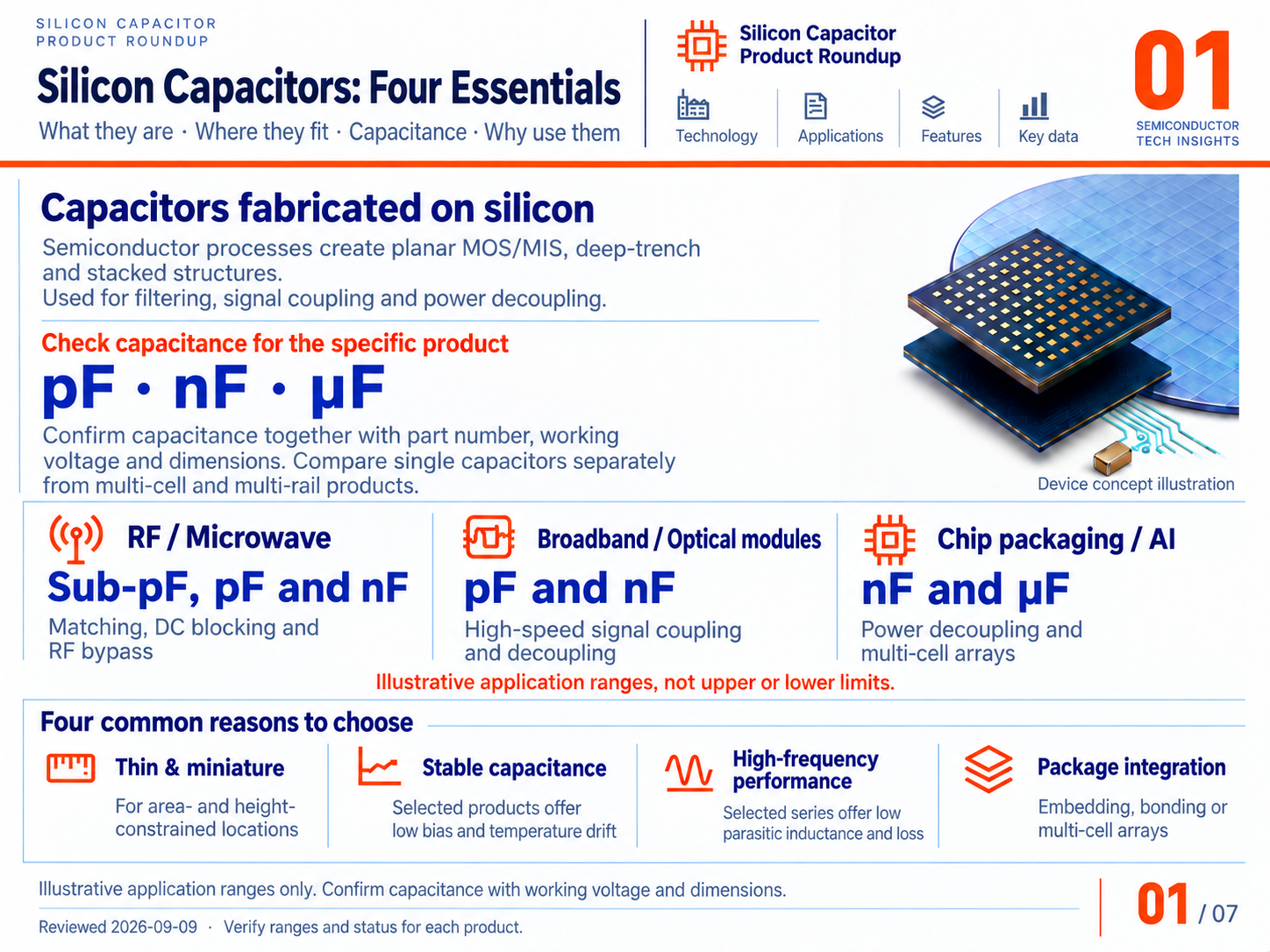
Capacitance requirements span a wide range. RF matching circuits often use high-precision sub-pF products, whereas power decoupling can require nF- to μF-class solutions. Selection must distinguish single-capacitor capacitance, total capacitance of a multi-cell array, and total capacitance across multiple power rails. These are different metrics.
2. Product categories and representative suppliers
Thin decoupling and advanced packaging
This category includes Murata, ROHM, Empower Semiconductor, Samsung Electro-Mechanics and AP Memory. Product formats range from discrete devices to embedded capacitors and capacitor interposers. The key metrics are single-capacitor capacitance, total array capacitance and capacitance density.
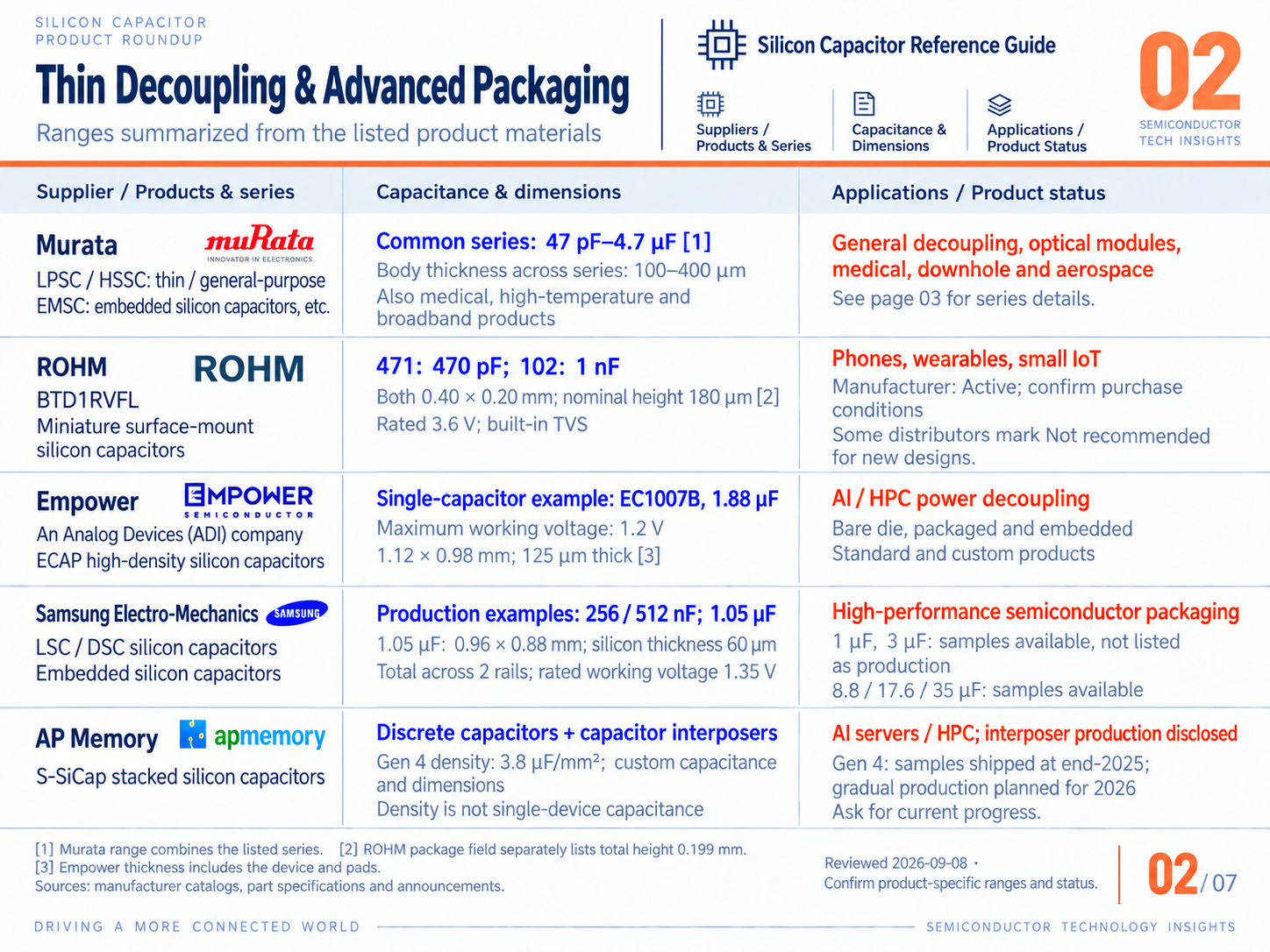
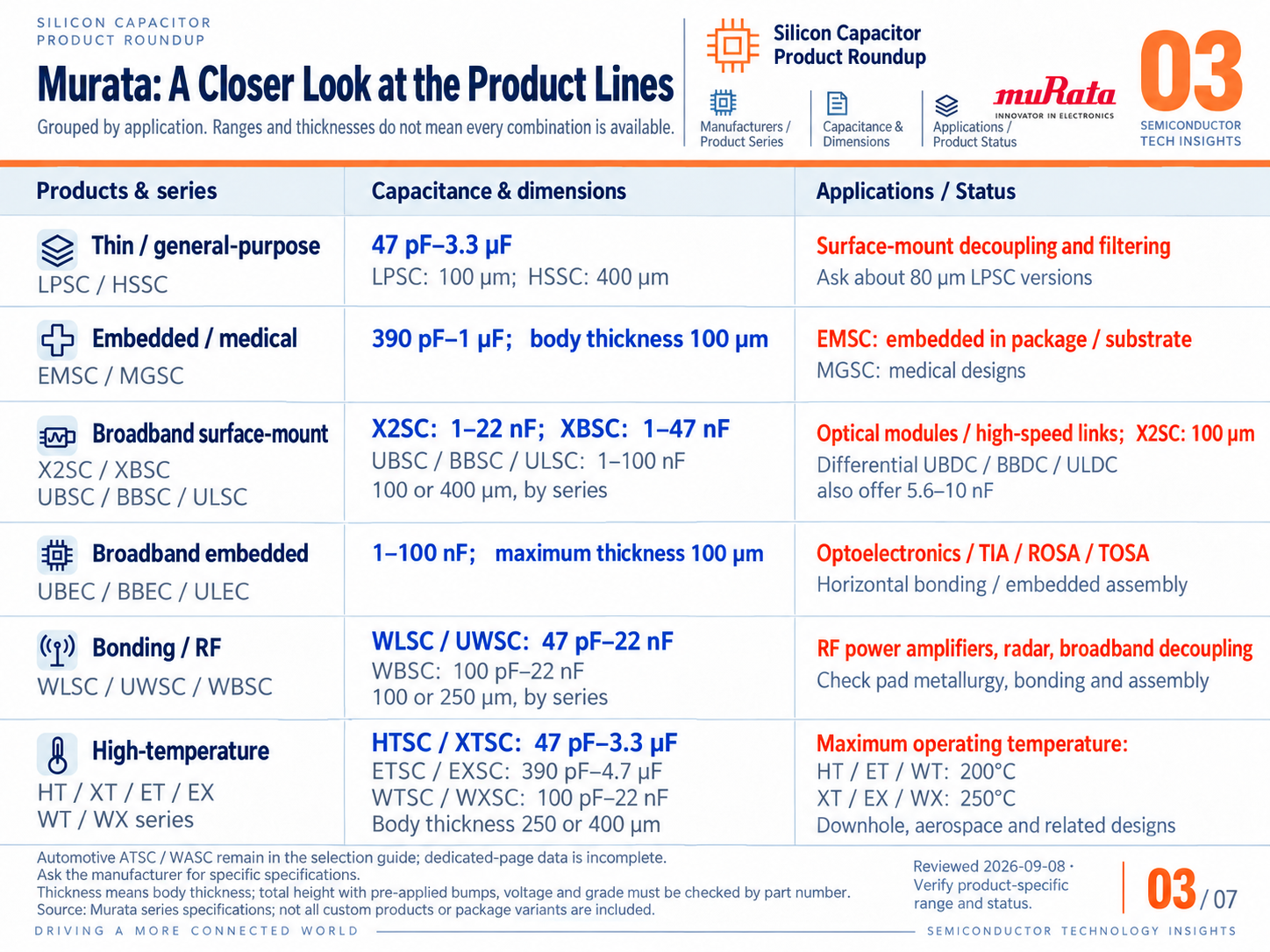
Murata's portfolio includes separate series for general-purpose, medical, broadband, wire-bonding and high-temperature applications. Even within one series, capacitance, voltage limits and thickness must be checked against the complete part number. A series-wide range is not a specification for an individual device.
Overview of Chinese suppliers
Chinese suppliers include Launchip, SUNA, FOIN Micro, INSTON and SENWAN. The completeness of public documentation varies. Available material describes series ranges, production capabilities and representative products, while some parameters still require manufacturer confirmation.
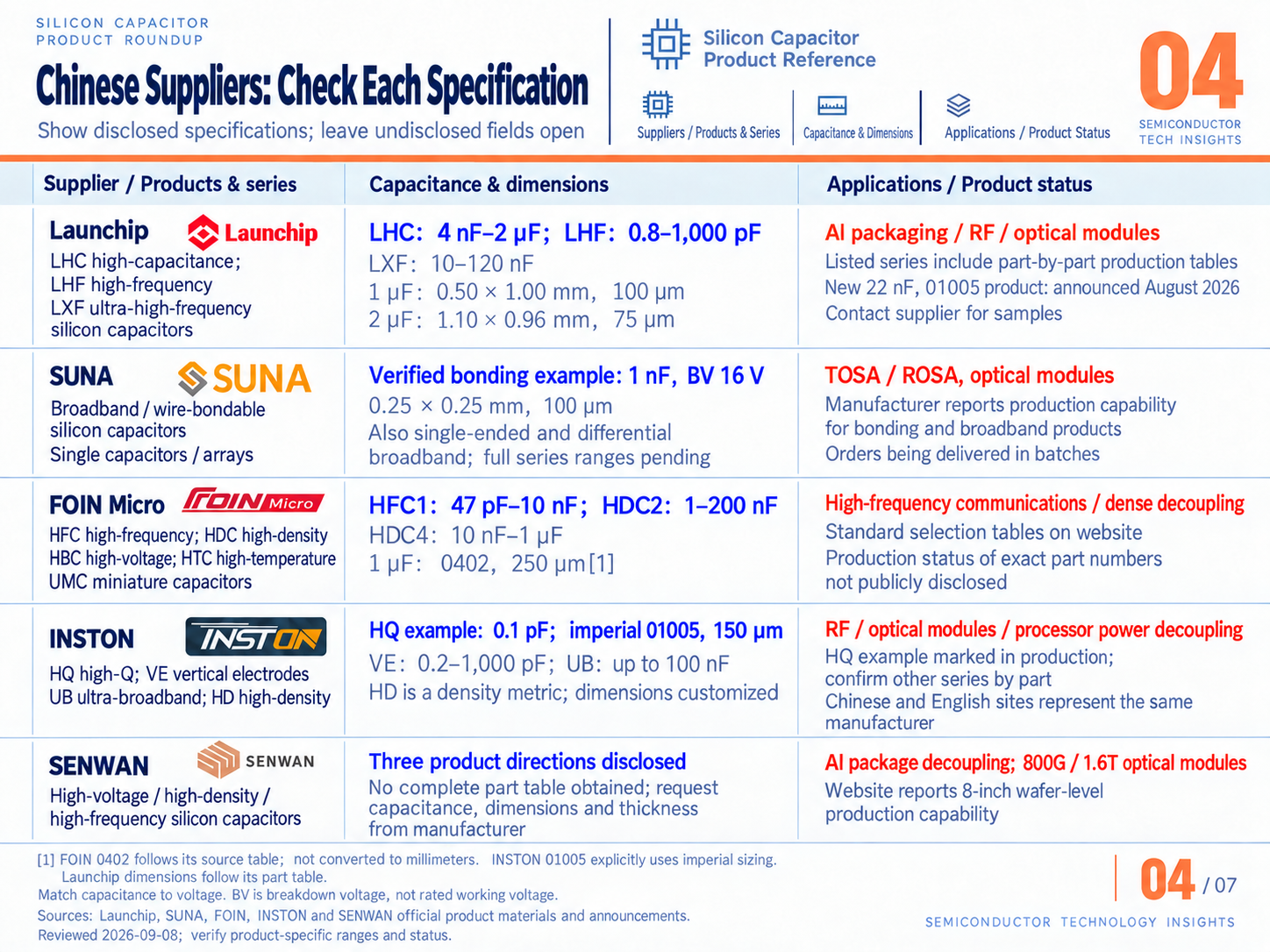
A standard selection table, a stated mass-production capability and a specific part number already in mass production are three different things. Verify specifications and supply status individually.
RF and microwave products
Silicon-capacitor suppliers for RF and microwave applications include KYOCERA AVX, Skyworks, Vishay, MACOM and US Microwaves. In addition to capacitance, selection depends on operating frequency, loss characteristics, pad structure and mounting method.
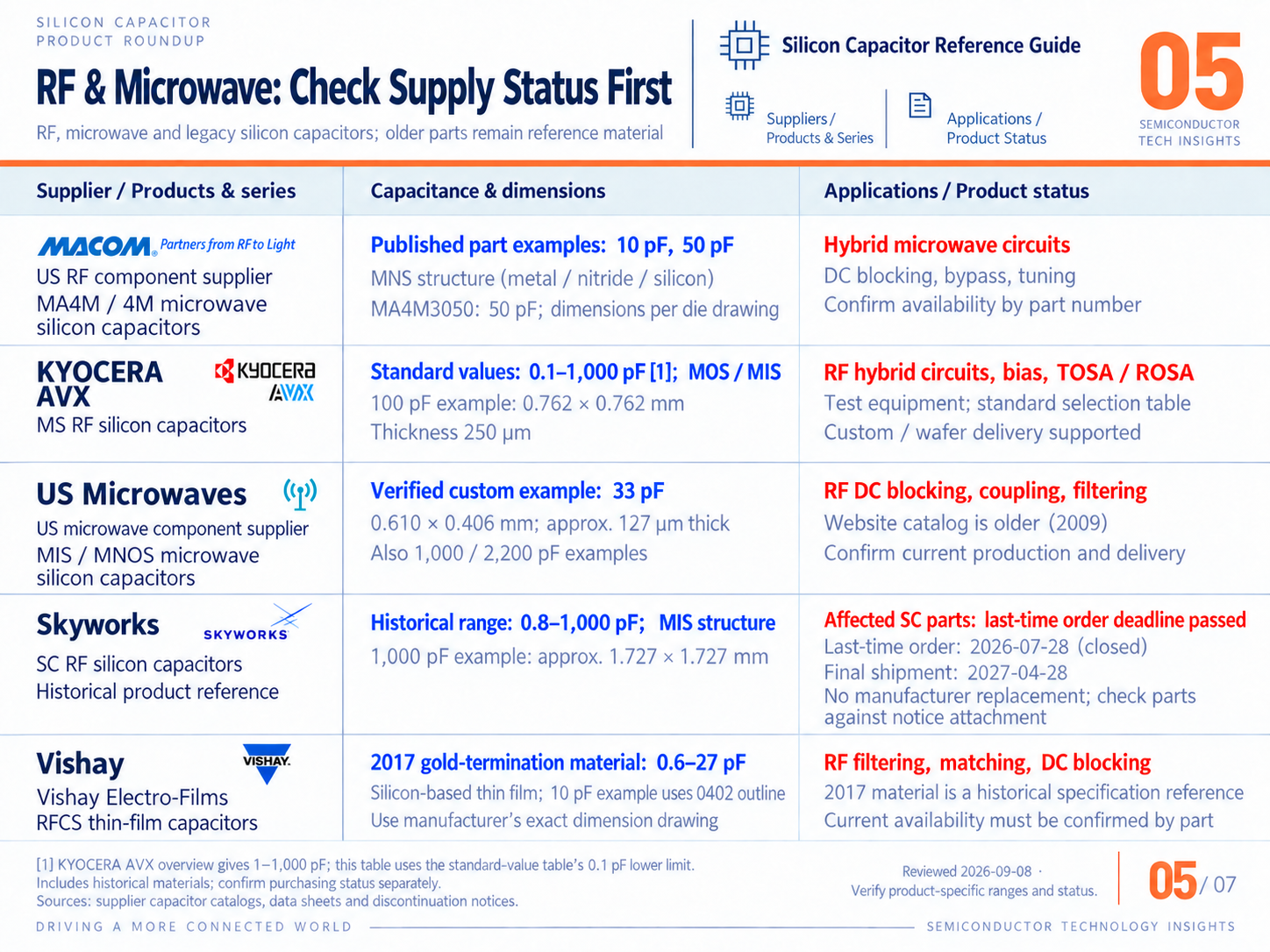
Historical part numbers can still serve as specification references, but their inclusion does not establish current production availability. Confirm availability and lead times before adoption.
3. Important selection considerations
Evaluate voltage limits and dimensions together
A comparison of three roughly 1 μF-class products from Murata, Launchip and Samsung Electro-Mechanics illustrates the problem. Samsung's 1.05 μF figure is the total across two power rails. The three products also differ in voltage definitions and thickness specifications. Planar area alone cannot establish which performs better.
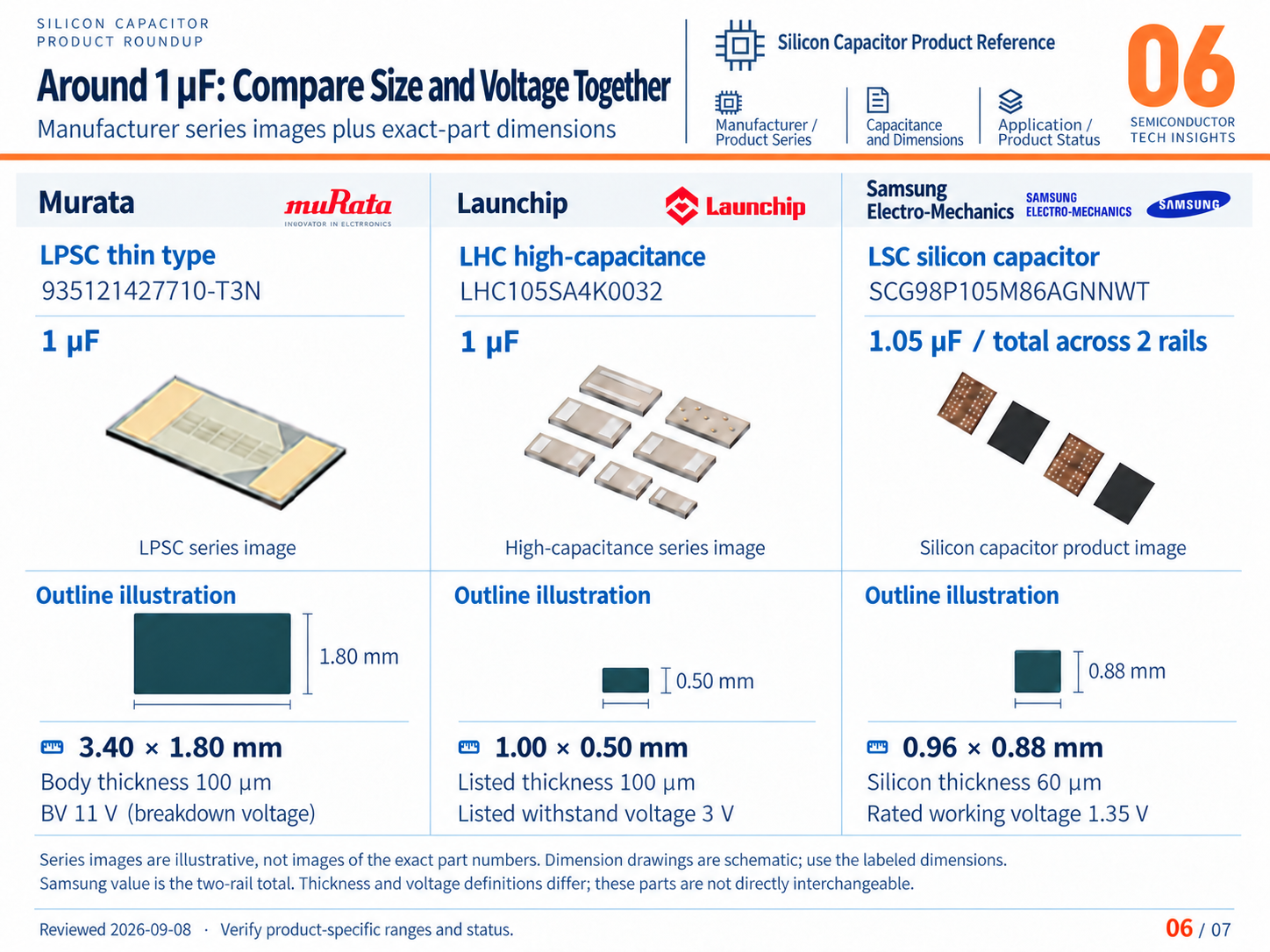
Series photographs are illustrative and do not necessarily show the specific part number. Dimension drawings are schematic; use the annotated numerical dimensions for actual length and width.
Identify the voltage rating associated with each capacitance
FOIN Micro's HDC4 series illustrates the capacitance–voltage tradeoff. Within the same outline—a 0402 package with 250 μm thickness—different capacitance options have different breakdown voltages (BV).
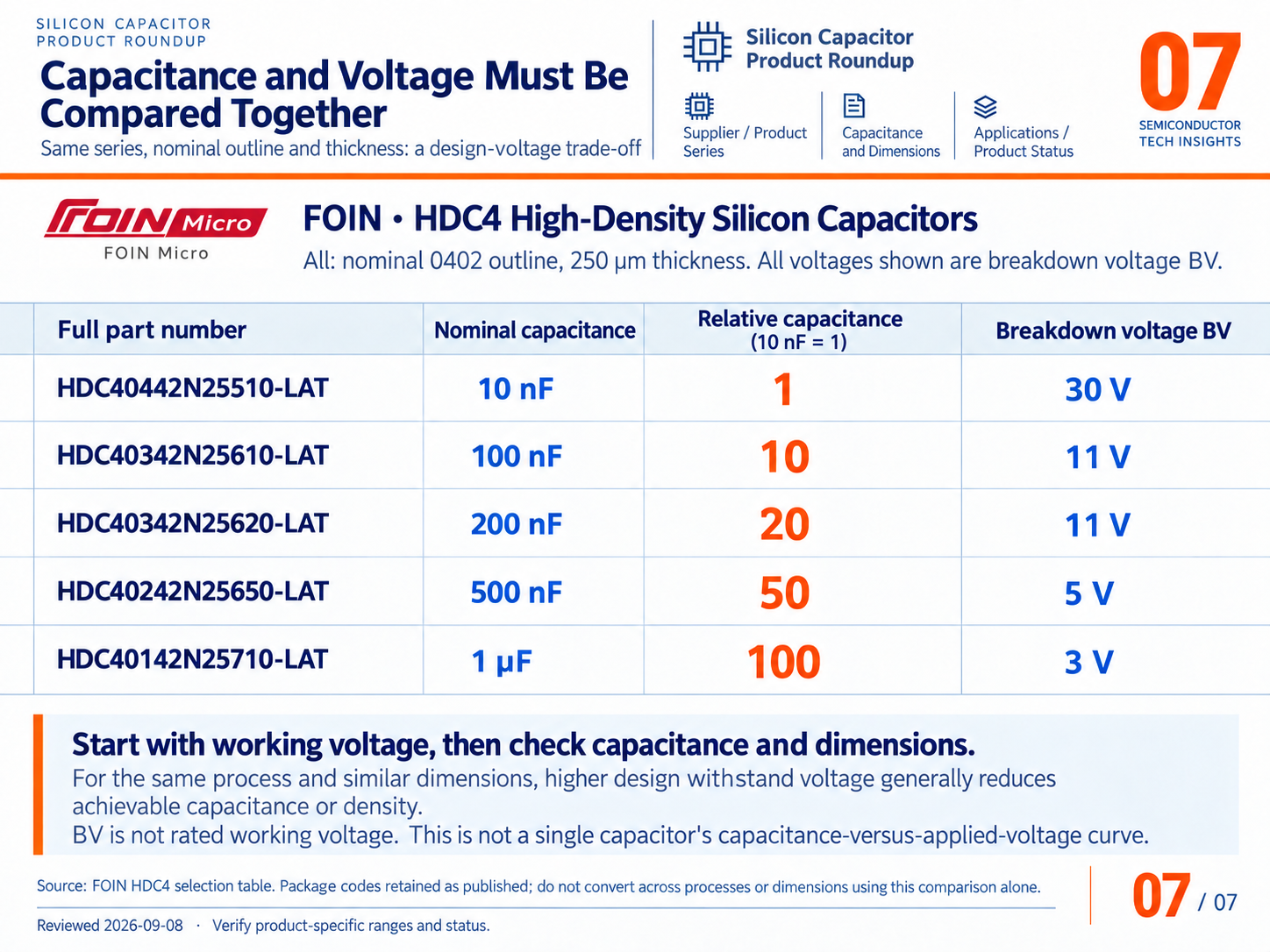
- 10 nF: BV of 30 V
- 100 nF / 200 nF: BV of 11 V
- 500 nF: BV of 5 V
- 1 μF: BV of 3 V
These are specification differences between distinct product designs, not the capacitance-versus-applied-voltage curve of one capacitor. Breakdown voltage (BV) is not equivalent to rated working voltage. Consult the specific product datasheet for the allowable continuous operating voltage.
This reference collection draws on public documentation from representative manufacturers and does not cover every supplier or part number. Parameters and product status reflect the source review snapshot. Use the manufacturer's latest datasheet and supply confirmation for actual component selection.