
Hall-effect sensors are nowhere near retirement, but TMR devices are beginning to compete for some of their positions in the BOM.
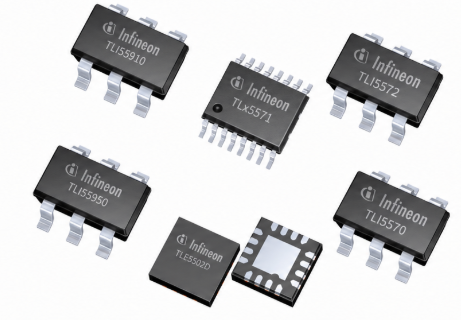
In June 2026, Infineon expanded its XENSIV TMR magnetic-sensor portfolio. TLI55910 and TLI55950 target position sensing; TLI5570 and the follow-on TLI5572 address current sensing; TLE5571 is aimed at overcurrent protection; and the automotive-qualified TLE5502D moves into safety-related uses such as motor-angle, steering, and braking systems.
The important signal is not simply that Infineon added several TMR part numbers. TMR is moving beyond low-power switches in consumer electronics and into automotive angle sensing, power conversion, and high-bandwidth current measurement. Infineon's own positioning is explicit: TMR is no longer just a supplement, but one of four magnetic-sensing technologies alongside Hall, AMR, and GMR.
That raises the sourcing question: China-based suppliers already sell TMR ICs, so why is automotive substitution still difficult?
1. If TMR Performs Better, Why Have Hall Sensors Not Disappeared?
TMR stands for tunneling magnetoresistance. In simplified terms, a magnetic field changes the electron-tunneling state between magnetic materials, and the sensor converts that change into an electrical signal. Typical advantages include high sensitivity, a strong signal-to-noise ratio, and low power consumption. TMR can also produce a useful signal across a wider air gap or with a smaller magnet.
Those characteristics are attractive in vehicles. Electronic water valves, oil pumps, wiper motors, pedals, steering wheels, and electric power-steering systems all need to determine the position of a shaft, valve, or actuator. A smaller magnet or a more forgiving installation distance can make the mechanical design easier.
In current sensing, TMR can also avoid some of the power loss and parasitic-inductance limitations of a shunt resistor. Infineon specifies bandwidth of at least 1.1 MHz for TLI5570, which is primarily positioned for industrial and consumer current sensing. TLI5572 and TLE5571 extend the roadmap toward high-power current measurement and fast overcurrent protection.
High sensitivity, however, does not guarantee a clean sweep. Hall solutions already offer mature signal conditioning, digital interfaces, diagnostic functions, familiar engineering workflows, and a well-developed cost structure. AMR and GMR devices have also accumulated years of use in angle, speed, and automotive position sensing.
TMR is therefore most likely to win selected Hall positions where air gap, magnet size, power, noise, or bandwidth matters—not every Hall-sensor line in the BOM.
2. China-Based TMR Suppliers Have Real Products; the Gap Is No Longer Simply “Do They Have a Chip?”
China-made TMR products are no longer confined to research papers or laboratories.
MultiDimension Technology's TMR3081 is a 360° analog angle sensor in a TSSOP8 package. It outputs differential SIN/COS signals, operates with a published magnetic-field range of 200-800Gs, and carries a published angle error of 0.8°. In July 2026, the company announced that TMR3081 had passed AEC-Q100 and NEVC testing and certification and had entered full production with stable supply.
The public status still needs careful interpretation. MultiDimension Technology's latest Chinese announcement and data sheet state AEC-Q100 compliance, while some earlier English product pages continued to say that qualification was in progress. This may simply reflect unsynchronized website updates. A sourcing or program team should still obtain the qualification report for the exact part number, package, and revision, and verify the QTP, production lot, and change history. A screenshot of a webpage is not sufficient automotive evidence.
More importantly, public information does not identify specific automotive customers for TMR3081 or demonstrate high-volume adoption in safety-critical steering or braking systems. A supplier's production announcement establishes product availability. It does not equal a customer nomination, and it does not make the device a primary source in a vehicle platform.
China-based suppliers are also pursuing different product paths. QST's KTM5900 combines TMR sensing, dual 16bit ADCs, and angle calculation for high-speed servo motors. Its product page lists a maximum speed of 180000rpm, but does not present the device as automotive-qualified.
NOVOSENSE's NSM1051 is an industrial-grade, low-power TMR switch. The 156 Hz sampling version can draw as little as 200nA and is intended mainly for metering, proximity detection, and reed-switch replacement.
All three are TMR devices, but they belong in three different BOMs: automotive angle sensing, industrial encoders, and low-power switches. Adding them together and declaring complete China-based TMR substitution says very little about a real design.
3. A 0.8° IC Error Can Become Something Very Different Inside a Motor
A magnetic sensor rarely works independently of its magnet and mechanical structure.
Magnet material and size, mounting height, air gap, eccentricity, tilt, temperature drift, and stray fields from a nearby motor can all affect the final angle result. The error in an IC data sheet is normally measured under specified magnetic-field, temperature, and installation conditions. It does not automatically equal system-level error.
TMR3081 provides analog differential SIN/COS outputs, so an external ADC, MCU, and angle algorithm must complete the measurement chain. MultiDimension Technology's published off-axis encoder example shows that multipoint calibration can improve angle accuracy in a particular implementation. That is a result of the magnetic circuit, mechanical design, and calibration algorithm working together; it cannot be treated as a universal device specification for every TMR3081 design.
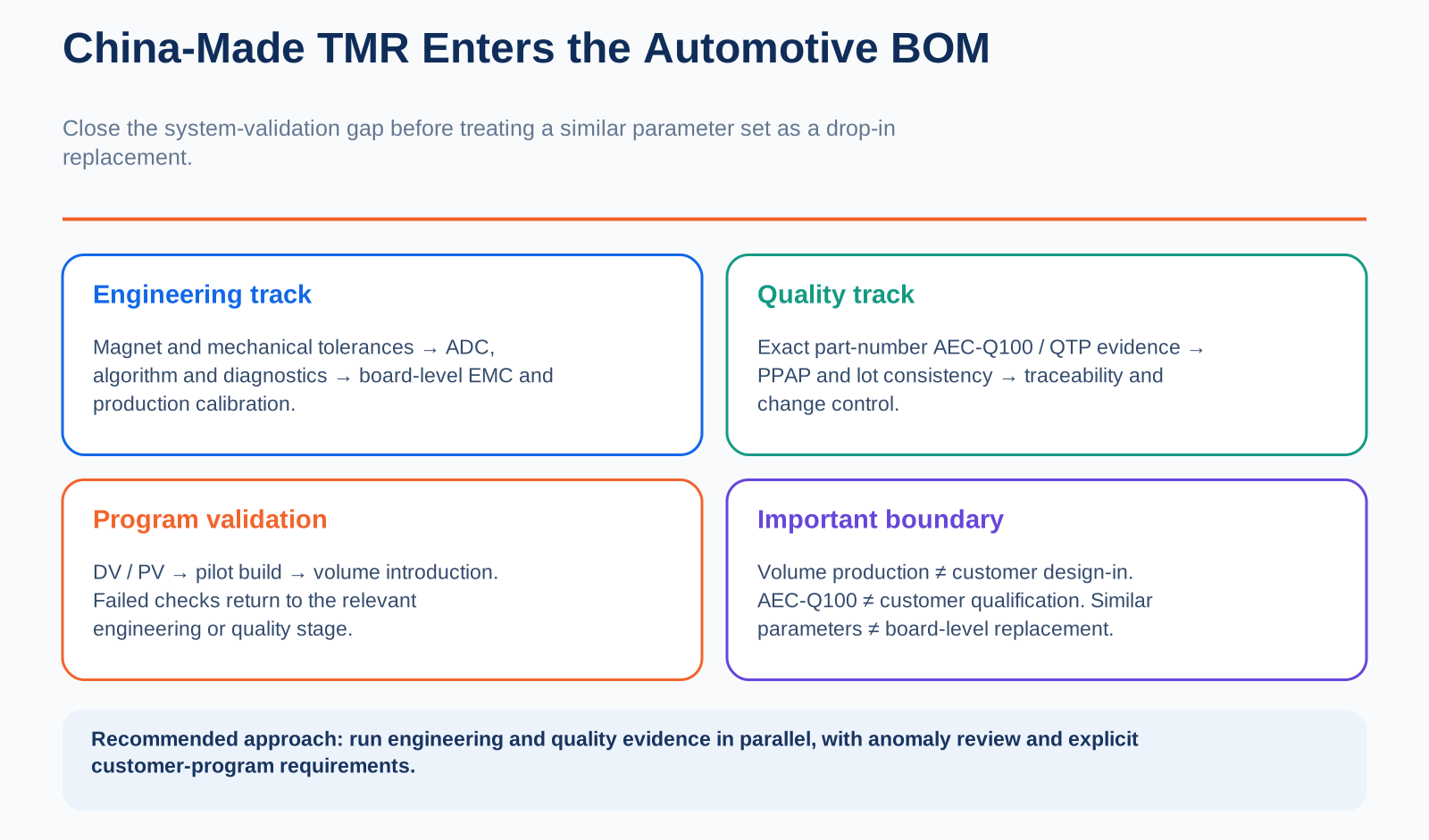
This is the layer most often underestimated in China-based component substitution. The customer appears to be buying one sensor, but is actually qualifying a complete system: IC, magnet, mechanical tolerances, ADC, algorithm, and diagnostics.
If the existing design uses a Hall angle sensor with digital output and internal compensation, moving to an analog TMR device may require changes to the magnet, PCB, ADC channels, software, and production-line calibration equipment. Even if the IC costs less, the system migration may not.
4. AEC-Q100 Is an Entry Ticket; Functional Safety Is the Deeper Automotive Barrier
AEC-Q100 primarily evaluates the reliability of a packaged IC under temperature, humidity, lifetime, electrostatic, and mechanical stresses. It is essential, but passing AEC-Q100 does not complete customer qualification or prove that a device satisfies a system's functional-safety goal.
Infineon's TLE5502D illustrates the distinction. It is not only an AEC-Q100 Grade 0 automotive angle sensor; it also uses a dual-die architecture, provides two independent differential signal paths, and is offered as an ISO 26262 SEooC supporting safety requirements up to ASIL D. The supplier data sheet still states that external safety mechanisms are required to achieve ASIL D. Even a dual-die product from an international supplier cannot claim an ASIL D vehicle system without system-level diagnostics.
For China-based suppliers, the next gaps are not limited to headline sensor specifications. Programs also require usable QTP and PPAP documentation, failure-mode analysis, diagnostic coverage, lot-to-lot consistency, change control, long-term supply, and magnetic-circuit and algorithm tools that customers can put directly into their development process.
A lower-risk qualification path starts with new programs, industrial servos, electronic water valves, pumps, and general actuators, then moves progressively toward steering and braking applications with stricter redundancy and functional-safety requirements. “Similar parameters” should not be interpreted as a drop-in replacement on an existing board.
5. China-Based TMR Competition Has Moved from Filling an IC Gap to Completing a System
Infineon's expanded TMR portfolio shows the technology moving from position sensing into angle, current, and overcurrent protection. Products from MultiDimension Technology, QST, NOVOSENSE, and other China-based suppliers show that Chinese TMR capability already reaches several distinct markets.
What is easiest to overstate is the idea that once a supplier can make a TMR IC, Hall-sensor orders will move automatically.
The more realistic opportunity will appear first in new designs rather than forced substitutions in an old BOM; first where TMR can genuinely shrink the magnet, relax the air gap, or reduce power—not in every position-sensing function; and first with suppliers that can deliver the IC, magnetic design, algorithms, and quality evidence together—not simply the best-looking parameter table.
The IC determines whether a supplier can enter the competition. Magnetic design, algorithms, functional safety, and production consistency determine whether the device remains in the automotive BOM.
Disclaimer: This article is compiled from public information for industry discussion only. It is not investment, procurement, or part-selection advice. Confirm product specifications, qualification, supply status, and customer adoption with the manufacturer, customer, and authorized channel using the latest available documentation.