Automotive Capacitors and Isolated Drivers: Qualification and Repeat Orders Shape Chinese Substitution
For buyers evaluating Chinese alternatives, an automotive MLCC, an isolated gate driver and a precision inertial sensor present different substitution problems. They influence supply stability, fault shutdown and motion-estimation error despite occupying little space on a BOM. Recent manufacturer disclosures establish production and qualification progress, but suitability still depends on the actual circuit, manufacturing process and customer validation.
Equal capacitance does not establish an automotive MLCC replacement
Automotive capacitors must retain usable electrical performance under voltage, ripple and temperature while tolerating assembly stress, vibration and thermal cycling. Maximum nominal capacitance alone cannot summarize these requirements.
Weirong's September 2026 prospectus lists automotive 1210-size 100 μF and 220 μF products and describes bulk supply of the relevant high-capacitance families. The imperial 1210 code corresponds to approximately 3.2 × 2.5 mm. These are commercial delivery advances, but family-level voltage and capacitance ranges cannot be combined arbitrarily into a single part.

Figure 1. Original Chinese-language table from Weirong's September 2026 prospectus. Columns show size family, product illustration, capacitance, operating temperature and rated voltage. Separate range maxima do not define one orderable device.
TDK's September 2026 CNA6P1X7R2A106K250AE announcement describes a 3225 metric, or 1210 imperial, 100 V, 10 μF X7R capacitor with low-resistance soft termination. The product page reviewed for the Chinese article lists mass-production status, automotive use and AEC-Q200 compliance.
In 48 V power lines, this combination addresses voltage headroom, component count and board area. A resin electrode layer helps reduce mechanical stress transfer from board flex but introduces resistance trade-offs. Low-resistance termination therefore adds another design requirement beyond voltage, capacitance and mechanical reliability. Weirong's high-capacitance families and this TDK product demonstrate different capabilities; the available evidence does not establish direct interchangeability.
Eyang's December 2025 automotive list includes A1210X7R106K250N*R: 1210, X7R, 25 V and 10 μF, with the asterisk retained as a manufacturer code placeholder. Its footprint and nominal capacitance match the TDK example, but its voltage does not. A 25 V part cannot be placed directly across a 48 V line. Catalogue coverage also does not establish customer production adoption.
DC bias creates a further distinction. Class II ceramics such as X7R lose effective capacitance under applied DC voltage. TDK's July 2026 application explanation highlights capacitance at working voltage. Sample evaluation therefore needs bias curves, ripple heating, temperature and circuit margin, not just the nominal value.
Thinner dielectric and more layers can increase volumetric capacitance while tightening requirements for powder dispersion, film uniformity, alignment and defect control. Inconsistent batches can invalidate the confidence gained from a qualified sample.
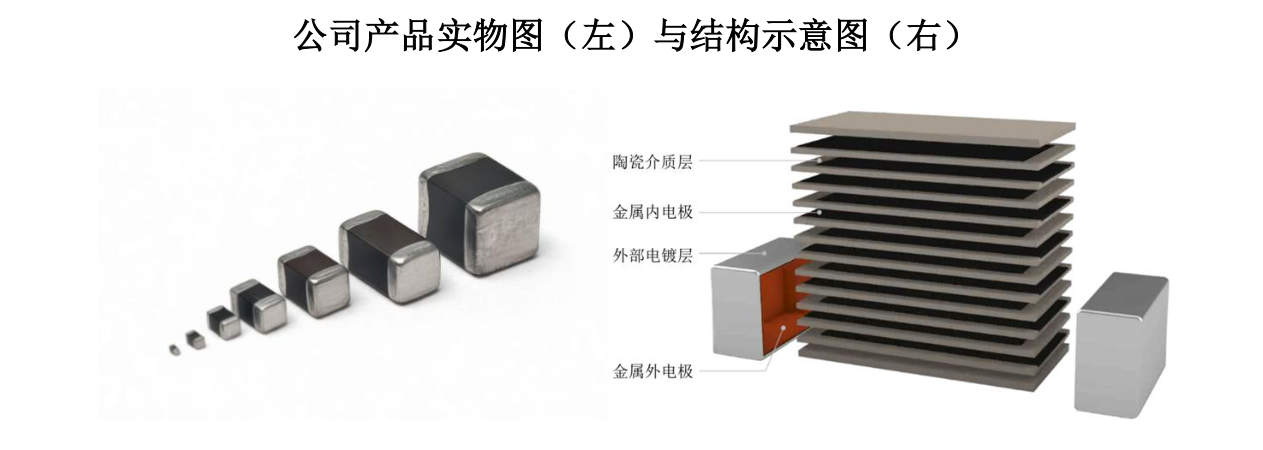
Figure 2. Original product and structure illustration from Weirong's September 2026 prospectus. Labels identify ceramic dielectric, internal metal electrodes, external plating and external electrodes. It does not establish a specific part's layer count or manufacturing yield.
Fenghua's 2026 material also lists EAM medium/high-voltage, AE soft-termination and AS safety-rated automotive families, with investor material identifying electric-drive, BMS and OBC applications. Chinese suppliers are broadening different parts of the portfolio. Part-specific curves, reliability evidence and batch traceability determine whether that coverage can enter an approved sourcing list.
OBC driver shipments do not establish traction-inverter adoption
An isolated gate driver transfers low-voltage commands to IGBT or SiC power switches, provides electrical isolation and participates in fault protection. Replacement changes switching speed, losses, interference and shutdown behaviour. Matching pins and peak current is insufficient.
NOVOSENSE's June 2026 NSI6911F announcement specifies SiC/IGBT support, 19 A peak drive capability and a 12-bit isolated ADC, combining drive, sensing and diagnostics. A May announcement confirmed TÜV Rheinland ISO 26262 ASIL D functional-safety certification. Target applications include traction inverters, OBCs and DC-DC converters. The 19 A figure concerns gate drive, not motor current; actual peripheral savings depend on the design.
The interim report separately describes scale shipments of SiC-oriented single- and dual-channel drivers into OBC and other markets, scale shipments of first-generation functional-safety drivers, and second-generation sampling/testing plus multiple project nominations. It does not map every generational milestone to NSI6911F. That part's vehicle deployment requires separate confirmation.
OBC supply and traction-project nomination have different power stages, loads and protection arrangements. Prior experience supports a new programme but does not replace its validation. Nomination also precedes the development and qualification needed for vehicle production and recurring purchases.
Infineon's June 2026 1EDI3040AS and 1EDI3041AS introductions illustrate further integration for traction inverters. Both support IGBTs and SiC, multilevel slew-rate control, SPI configuration and diagnostics. Only the 1EDI3040AS additionally incorporates the closed-loop flyback controller described here; that function must not be extended to 1EDI3041AS.
Faster switching can reduce part of the switching loss while increasing the need to manage parasitic overshoot and ringing. Protection must match the power device's limits. Configurability, fault behaviour and development tools therefore affect migration cost alongside headline electrical ratings.

Figure 3. Infineon's April 2026 1EDI3040AS evaluation-board material, including double-pulse generation, a dedicated flyback supply and measurement access. This is manufacturer evaluation material, not a customer's production circuit.
Infineon explicitly limits its complex-device-driver reference code to prototyping; customers must develop and validate production software. Boards, configuration tools and safety support reduce some work without proving system-level safety.
Chinese suppliers likewise need reproducible evaluations, complete safety documentation and failure-analysis support. Changing power modules can require retesting gate resistors, supplies, layout and fault handling. Chipanalog's CA-IS3265/3266-Q1 functional-safety isolated drivers expand the options for evaluation, but recent product and solution presentations do not establish customer shipment volumes.
Inertial MEMS performance depends on vibration and calibration
Gyroscopes measure angular velocity and accelerometers measure acceleration. Industrial users need stable outputs during movement, temperature changes and strong vibration as well as at rest. One small drift number answers only part of the question.
Xin Dong Lian Ke's 2026 interim report says industrial gyroscopes were in production and broad sampling. Monolithic three-axis gyroscopes were still undergoing parallel tape-outs at two to three foundries, reliability verification and optimization. A six-axis IMU with functional-safety objectives remained in development. Single-axis devices, multi-axis assemblies and monolithic integration have different assembly, calibration and validation requirements.
Bias instability describes fluctuations under particular test conditions. Power-cycle offsets, thermal drift and vibration response need separate evaluation. It cannot directly determine an equipment system's one-hour positioning error without considering mounting, algorithms, other sensors and operating conditions.
Murata's November 2026 SCH16T-K30 introduction demonstrates the importance of dynamic conditions. The industrial six-axis IMU targets excavators, heavy-machinery control and surveying poles. Its typical gyroscope bias instability is 0.3°/h, while the announcement also emphasizes vibration tolerance through adjusted accelerometer MEMS damping that suppresses unwanted high-frequency vibration.
The disclosed 180 g figure is a saturation limit at 1000 Hz, not its normal measurement range. Avoiding clipping under strong vibration is a distinct capability. A low-drift sensor that repeatedly saturates cannot provide complete motion information.

Figure 4. Murata's official November 2026 SCH16T-K30 product image. Samples were available at announcement, with mass production planned for the end of 2026. It was not established volume delivery or an automotive-grade offering.
Murata identified the part as under development, with specifications subject to change, and not for automotive use. It illustrates an industrial requirement rather than a direct ranking against a Chinese single-axis gyroscope. Comparisons need matched axes, bandwidth, temperature, range and calibration conditions.
MEMS structures and fabrication are closely linked. Xin Dong Lian Ke describes manufacturing adapted to its foundry processes rather than a completely generic handoff. Structure, packaging and calibration jointly determine output, and production must reproduce those conditions across batches. Industrial production creates valuable application feedback, but new-product revenue still requires actual adoption evidence.
Repeatable delivery is the commercial test after qualification
Chinese supply now includes bulk automotive MLCC families, scale isolated-driver shipments in selected automotive power applications, and industrial inertial-sensor production. Expansion depends on engineering records and delivery outcomes for each application.
Xin Dong Lian Ke's first-nine-month 2026 revenue was approximately RMB207 million, down 48.42%, while R&D investment was about RMB104 million, up 15.02%. The company cited major-customer demand changes and customer concentration among the revenue factors. Product capability and current orders can move in different directions while development spending continues.
NOVOSENSE reported approximately RMB4.226 billion revenue, up 78.66%. Its first-nine-month net result attributable to shareholders excluding non-recurring items remained negative, although the third quarter alone turned positive. It also reported investment-related fair-value gains. These company-level figures show that revenue expansion and profit conversion differ; they do not reveal one driver's margin.
After certification, suppliers must manage material batches, production changes, test coverage and failure analysis. After orders begin, repeat purchases, delivery quality and corrective-action closure matter. Outsourced wafer or packaging operations still require supply-chain coordination; a Chinese brand does not establish domestic sourcing at every step.
Changing ceramic powder or packaging can alter previously qualified conditions. The parties need to identify affected part numbers, determine which results remain valid and agree on additional customer tests. Clear change records and validation responsibilities connect upstream localization with downstream reliability.
The useful research unit is a part or family in a defined application: effective capacitance and reliability for MLCCs, platform validation and production software for drivers, dynamic error and batch calibration for MEMS. Suppliers strengthen their position when qualified samples become consistent batches and support continues through platform changes and higher production volumes.
Based on recent manufacturer material and public disclosures. Application suitability and supply status remain subject to project validation and manufacturer confirmation.