
An August 6 project-status response placed three Motorcomm automotive product lines on the same page: the gigabit automotive PHY project was complete, while the 8/11-port TSN switch and first-generation 6.4G SerDes projects still had test and optimization work underway. The products appear together in a "PHY + switch + SerDes" stack, but they are not at the same maturity level.
At the Beijing Auto Show in April, Motorcomm showed YT78 serializers, YT79 deserializers and YT99 TSN switches. On May 19, the HSMT working group formally started product-level chip verification. Taken together, the events show a market moving from product announcements toward validation and placement in real vehicle BOMs.
PHYs, switches and SerDes devices perform different jobs and need different competitor sets. The question is not whether Motorcomm has filled every box in a portfolio chart, but which products occupy comparable BOM positions, how far each has progressed and what remains before it can be considered mature.
1. Put each device in the right place: translator, traffic hub and video link
An automotive Ethernet PHY sits between an ECU or domain controller and the cable. It translates chip-level data into electrical signaling that can travel reliably over a single twisted pair.
A switch is the traffic hub. It aggregates Ethernet ports and forwards packets according to priority and schedule. SerDes connects cameras or displays to a domain controller through a high-speed media link. It carries high-bandwidth video toward the controller and sends control data back toward the sensor.
The selection criteria are therefore different:
- For a PHY: data rate, MAC interface, low-power wake-up, EMC and cable diagnostics.
- For a switch: port matrix, integrated PHYs, TSN, security core and SDK.
- For SerDes: protocol, forward and reverse rate, aggregation, companion devices and cross-vendor interoperability.
Occupying a similar BOM position only means the parts may enter the same sourcing exercise. It does not prove pin compatibility, and products built around different link protocols cannot be assumed to interoperate.
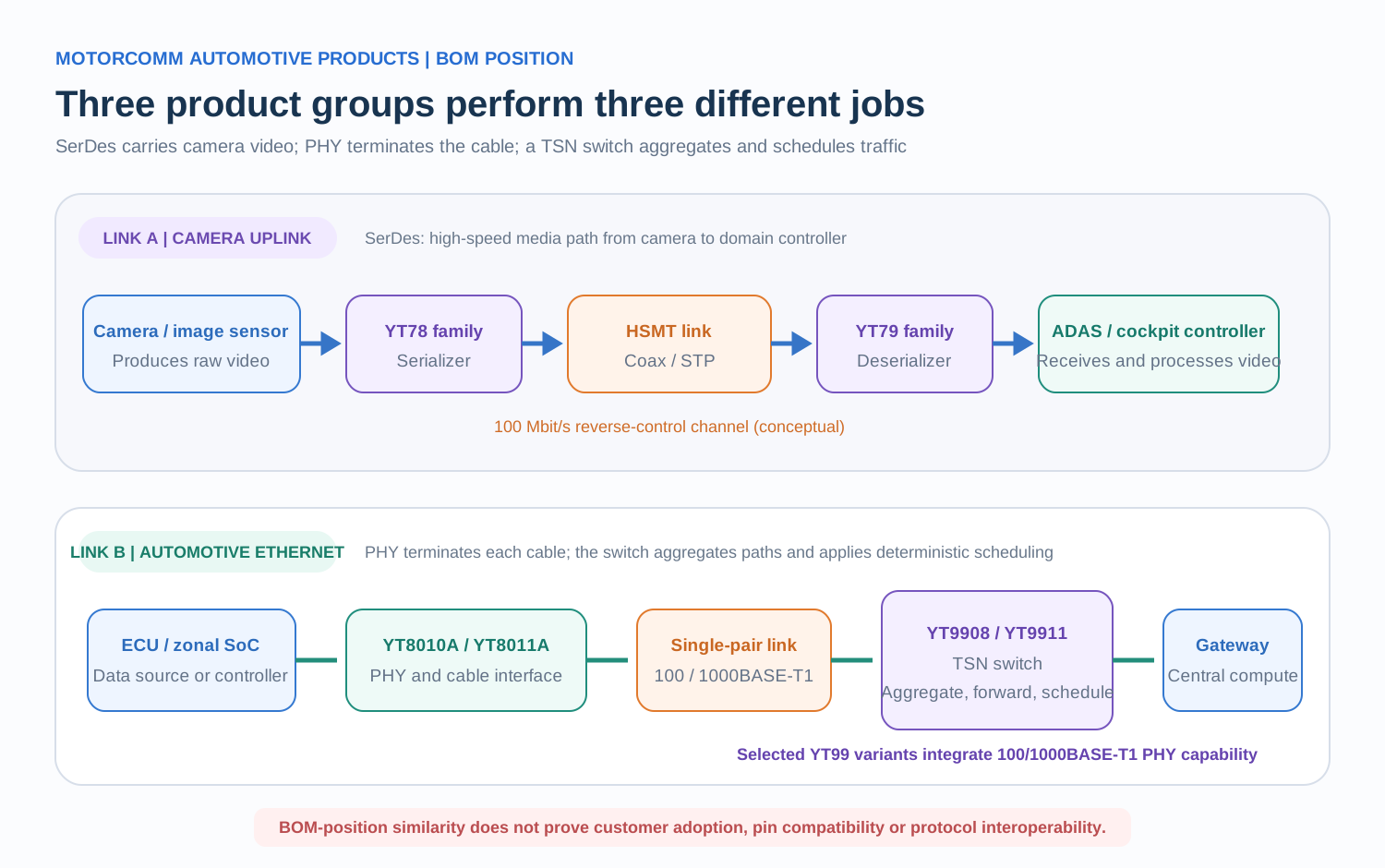
2. YT8011 automotive PHY: the most mature line, but suffixes matter
For 100 Mbit/s automotive Ethernet, Motorcomm's YT8010A supports 100BASE-T1 with RGMII, MII and RMII and comes in a 6 x 6 mm QFN36 package. Products in a similar BOM position include Broadcom BCM89811, Infineon's former Marvell 88Q1110/1111 and Jinglue JL3101.
Gigabit sourcing must go down to the suffix. YT8011A, YT8011AN and YT8011AR all support 100/1000BASE-T1. YT8011A and YT8011AN provide both RGMII and SGMII in 7 x 7 mm QFN48. YT8011AR provides RGMII only in a smaller 6 x 6 mm QFN40. The auxiliary sleep supply is 12 V for YT8011A and 3.3 V for YT8011AN and YT8011AR.
Even within the same Motorcomm family, the label "YT8011" is not a compatibility decision. Broadcom BCM89883/BCM89884, Infineon 88Q222xM, Realtek RTL9010AA and Jinglue JL3113 occupy adjacent selection ranges.
For SGMII hosts, BCM89883 is closer to YT8011A/AN. For RGMII, the 40-pin, 6 x 6 mm, TC10-capable BCM89884 is closer to YT8011AR. Similar package size and interface type still do not prove pin, power or external-circuit compatibility.
Infineon 88Q222xM provides RGMII and SGMII and publicly documents TC10, PTP, ASPICE Level 2 software and MACsec on selected versions. Public information confirms that Realtek RTL9010AA is a 1000BASE-T1, AEC-Q100 Grade 1 device, but is not sufficient to establish dual-rate capability, MAC interface, package and current lifecycle in the same detail.
The gap is therefore broader than transmit and receive speed. Security variants, diagnostics, software documentation and long platform history matter. Reliability labels must also be separated: AEC-Q100 addresses device reliability, whereas ASIL addresses functional safety. Grade 1 is not the highest AEC-Q100 temperature class; Grade 0 has a higher upper-temperature limit.
Among Motorcomm's three automotive lines, the PHY portfolio has the strongest production foundation. Any substitution claim still needs the complete suffix, interface and surrounding design.
3. YT99 TSN switch: one production foothold, with platform reuse still to prove
YT9908 and YT9911 target eight- and eleven-port combinations. Public family capabilities include integrated 100/1000BASE-T1 PHY functions, uplinks as fast as 10G and aggregate switching capacity above 25G.
Suffixes create material differences. YT9908AP has a richer interface set than YT9908CP. YT9911CP uses BGA and supports PCIe, while YT9911CL uses QFP without PCIe.
Products in a nearby sourcing range include Broadcom BCM8957X, Infineon 88Q5152/88Q6113, NXP SJA1110 and Realtek RTL9072/RTL9075. A valid third-party comparison cannot stop at eight, nine or eleven ports.
Infineon 88Q5152 is a nine-port switch with six integrated PHYs, dual Cortex-R52 cores, MACsec, an embedded HSM and trusted boot. The eleven-port 88Q6113 does not integrate T1 PHYs; most of its ports are RGMII, SGMII, XFI, PCIe or other MAC/SerDes interfaces. It can be compared with YT9911 by overall port scale, not by equal integration.
NXP SJA1110 emphasizes four pin- and software-compatible variants, hardware security, functional-safety support, an SDK, AUTOSAR drivers and an AVB synchronization stack. The competition is therefore among port architectures, security architectures and platform reuse—not only port count.
Motorcomm says YT99 is installed in production vehicles and has been introduced at more than ten automakers. Its August response also says selected 8/11-port programs still require functional optimization and yield improvement at particular rates. The statements can describe different SKUs and projects. The cautious conclusion is that YT99 has achieved a production foothold, while repeatability across vehicle platforms still depends on software, safety evidence, yield and stable supply.
4. YT78/79 SerDes: an open-standard opportunity with an ecosystem problem
Motorcomm's HSMT family includes three serializers—YT7821, YT7811F and YT7801—and six deserializers—YT7921, YT7911F, YT7901, YT7922, YT7912F and YT7902. The family covers forward rates of 2, 3.2, 4 and 6.4 Gbit/s with a 100 Mbit/s reverse channel.
The competitor map has three layers.
The first is the mature proprietary ecosystem. TI DS90UB971-Q1 belongs to FPD-Link IV and specifies a 7.55 Gbit/s line rate with a 6 Gbit/s video payload. ADI MAX96717 belongs to GMSL2 and supports 3 or 6 Gbit/s forward links with a 187.5 Mbit/s reverse channel. Their advantage includes serializers, deserializers, evaluation boards, power-over-coax support, debug software and established camera designs.
The second layer is same-protocol competition. Ruifake NS6312 + NS6003 and NOVOSENSE NLS9116 + NLS9246 also use HSMT and are more appropriate comparisons for a 6.4 Gbit/s link, 100 Mbit/s reverse channel, MIPI interfaces, functional safety and cross-vendor pairing.
The third layer contains other China-developed links such as R-Semi R-LinC. They may compete for a similar BOM position but cannot be assumed to connect to HSMT devices.
HSMT aims to reduce an automaker's dependence on one SerDes ecosystem through an open standard. The difficulty is making "open" real. Receiving a vendor ID or participating in early interoperability work is not product certification or stable volume production.
The product-level verification started in May covers function, performance, immunity, reliability and application behavior. Only when formal certificates, cross-vendor pairing lists, SoC support and production records become available will the open ecosystem become a dependable procurement option.
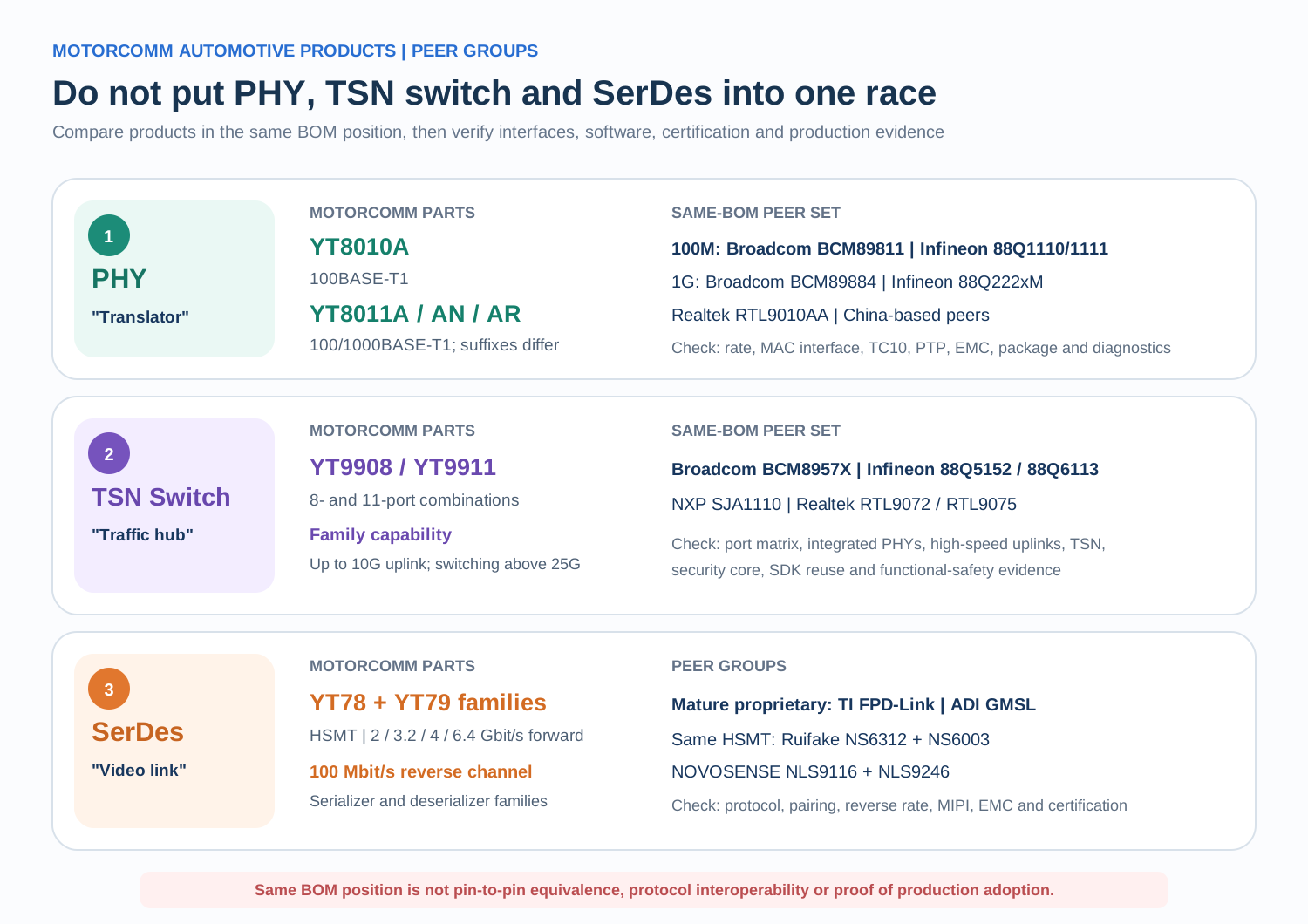
Conclusion: three product groups, three different gates
Motorcomm does not face one uniform international competitor. The PHY line must prove substitutability: suffix, interface, EMC and diagnostics must align. The switch line must prove reuse: one hardware and software platform must scale to more vehicle programs. The SerDes line must prove interoperability through cross-vendor pairing, formal certification and a usable toolchain.
The best measure of Motorcomm's automotive position is not whether the product catalog is full. It is whether YT8011, YT99 and YT78/79 turn "replaceable," "reusable" and "interoperable" into repeatable engineering facts. That is what gives a full-stack claim real weight.
This article uses manufacturer information, regulatory disclosures and organized public data available through August 28, 2026. It is not a specific part-substitution recommendation or investment advice.